
Renewed U.S. investment in 500 kV and 765 kV transmission is creating specialized equipment requirements while sustaining work at existing substations. Drawing on PTR’s dead-tank circuit breaker research, this article examines changing market value and demand patterns, and how manufacturing investment, utility qualification, and SF6-free technology affect the opportunities available to OEMs.
Introduction
Electricity transmission in the United States is expanding to accommodate rising power demand, renewable energy integration, and changing power flows across the grid. Data centers and industrial developments are increasing electricity requirements in particular regions, while new generation and the retirement of some conventional power plants are changing where electricity is produced. Utilities must assess whether existing lines and substations can be reinforced sufficiently or whether new, higher-capacity transmission corridors are needed.
Recent investment plans indicate renewed interest in extra-high-voltage (EHV) transmission. In December 2024, the Midcontinent Independent System Operator (MISO) approved a $21.8 billion portfolio that includes a 765 kV transmission backbone and associated 345 kV facilities. Southwest Power Pool (SPP) approved $8.6 billion in transmission projects in November 2025, while PJM approved approximately $11.8 billion in February 2026, including new 500 kV and 765 kV lines. Texas is also introducing 765 kV connections to reinforce supply to the Permian Basin. These figures refer to overall transmission-project investment, not expenditure on circuit breakers.
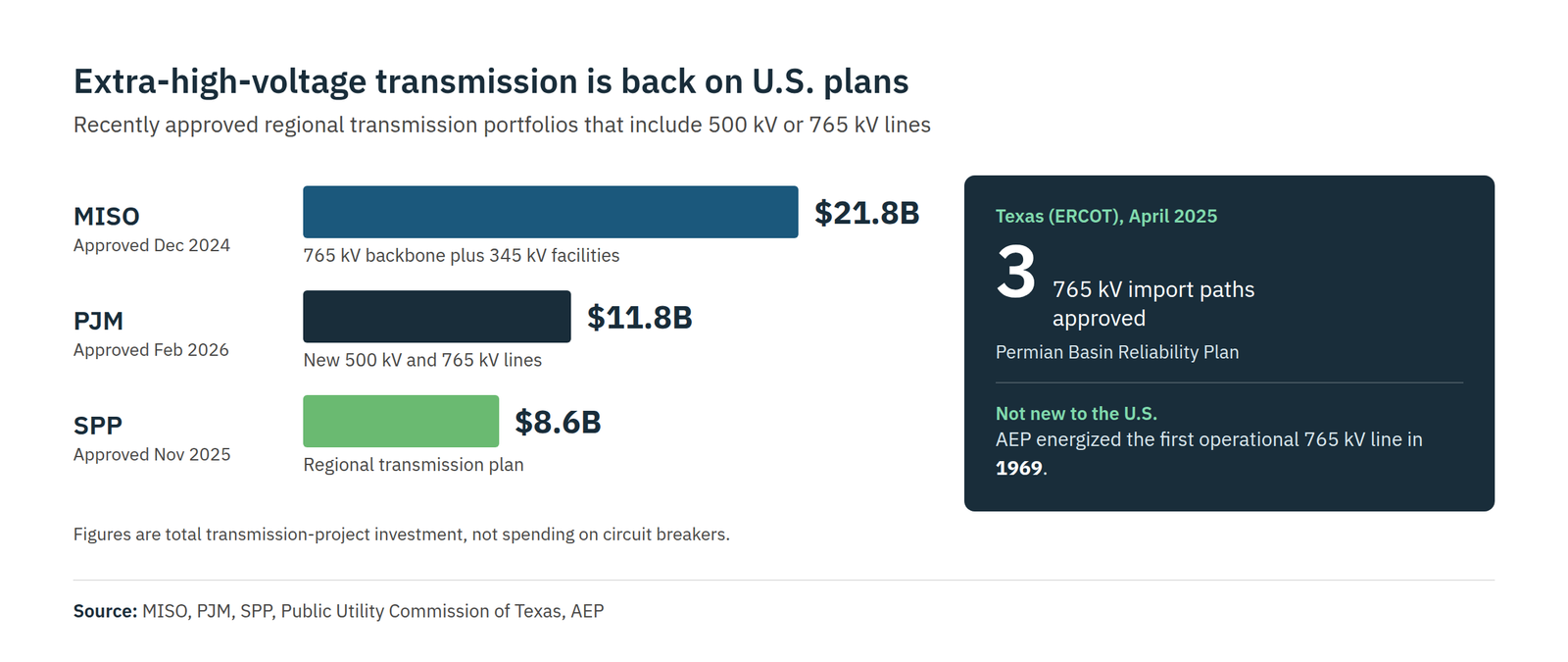
The voltage is not new to the United States: American Electric Power energized the first operational 765 kV line in 1969. The development worth examining is its planned expansion into additional networks. For breaker manufacturers, the strategic question is not limited to supplying 800 kV equipment for the new lines. It also concerns the substations connecting those lines to existing networks, the changing value of high-voltage equipment, and the ability of OEMs to qualify products for projects now moving through planning and engineering.
Why utilities are considering 765 kV again
Utilities can increase transmission capacity by uprating existing lines, building additional circuits, or developing new routes at higher voltages. The choice depends on distance, expected power transfers, available rights-of-way, reliability requirements, and total project cost. For large regional transfers, one higher-capacity route may be more practical than several parallel lower-voltage circuits, particularly when land access and permitting are difficult.
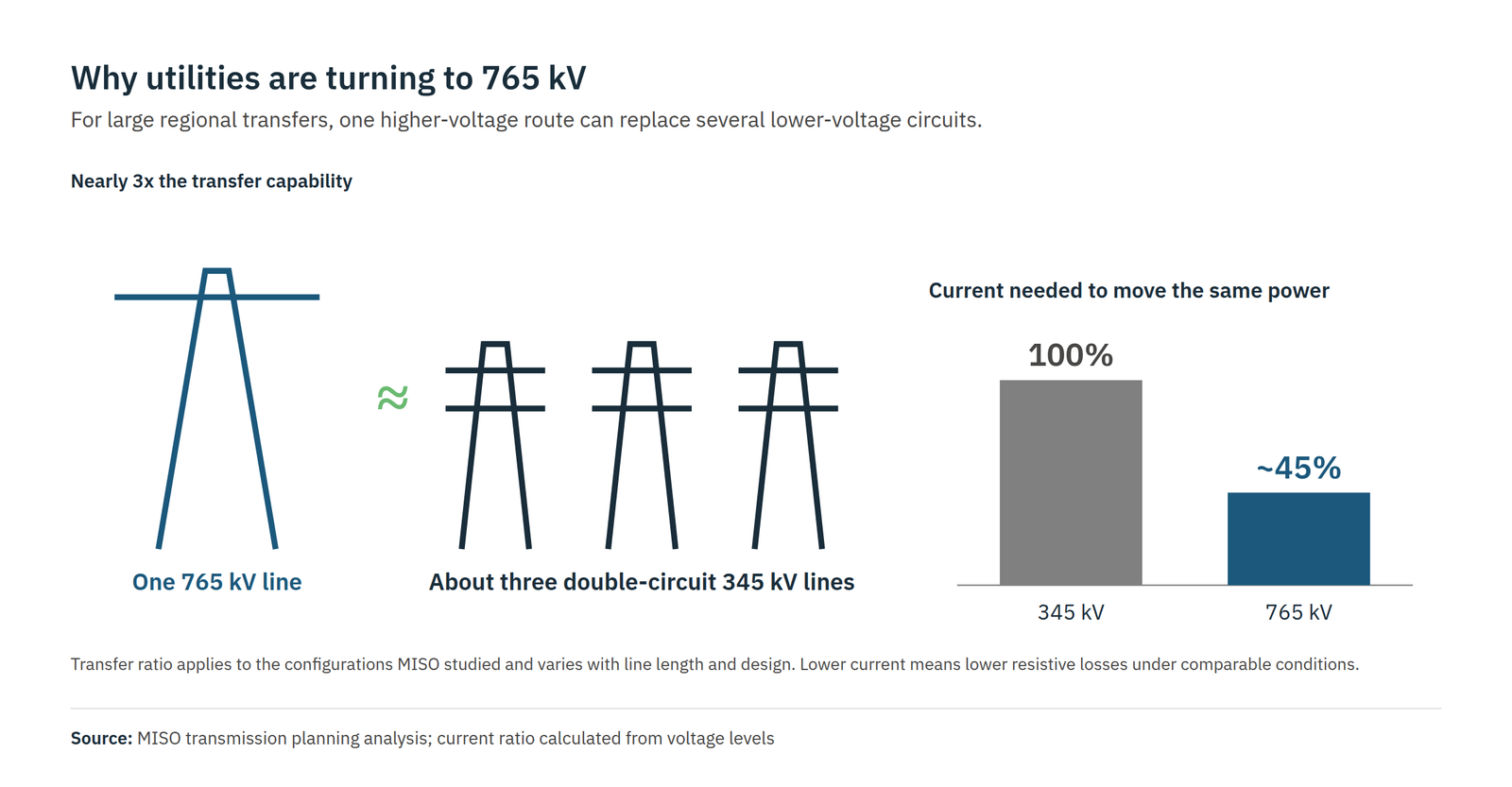
At a higher voltage, the same amount of three-phase power can be transferred at a lower current, reducing resistive losses under comparable conditions. MISO’s transmission planning analysis finds that a 765 kV line offers nearly three times the transfer capability of a double-circuit 345 kV line in the configurations studied. This is not a universal ratio; actual transfer capability depends on line length, conductor design, voltage support, and system stability. Higher-voltage infrastructure also requires larger electrical clearances, more demanding insulation, and, on long lines, equipment to manage reactive power. The economics therefore favor 765 kV where there is a sustained need to move substantial amounts of electricity.
The geographic spread of investment is important. MISO’s planned backbone addresses long-term needs across the Midwest, while SPP is developing additional high-capacity transmission in its region. In Texas, the Public Utility Commission approved three 765 kV import paths in April 2025 under the Permian Basin Reliability Plan. These programs differ in purpose and schedule, but all involve significant transmission-network development rather than a simple replacement of existing 345 kV or 500 kV lines.
How new transmission corridors affect breaker demand
The market implications extend into the substations required to connect new corridors to existing infrastructure. A 765 kV line needs terminal and switching facilities, and connections to a 345 kV network can require 765/345 kV transformer banks, line bays, and additional circuit breaker positions. A new 500 kV connection can likewise be accompanied by reinforcement at 230 kV or other transmission voltages. Where required, shunt reactors and related switching equipment add to the electrical scope.
A 765 kV nominal system normally uses 800 kV rated circuit breakers; 500 kV and 345 kV systems commonly correspond to 550 kV and 362 kV equipment classes. The distinction matters because a transmission program identified primarily as a 765 kV development can involve manufacturers with portfolios at several high-voltage ratings. The final requirement depends on the substation design and the number of connections, and some projects may use gas-insulated arrangements rather than conventional outdoor dead-tank breakers. Transmission mileage by itself does not establish the number or type of breakers purchased.
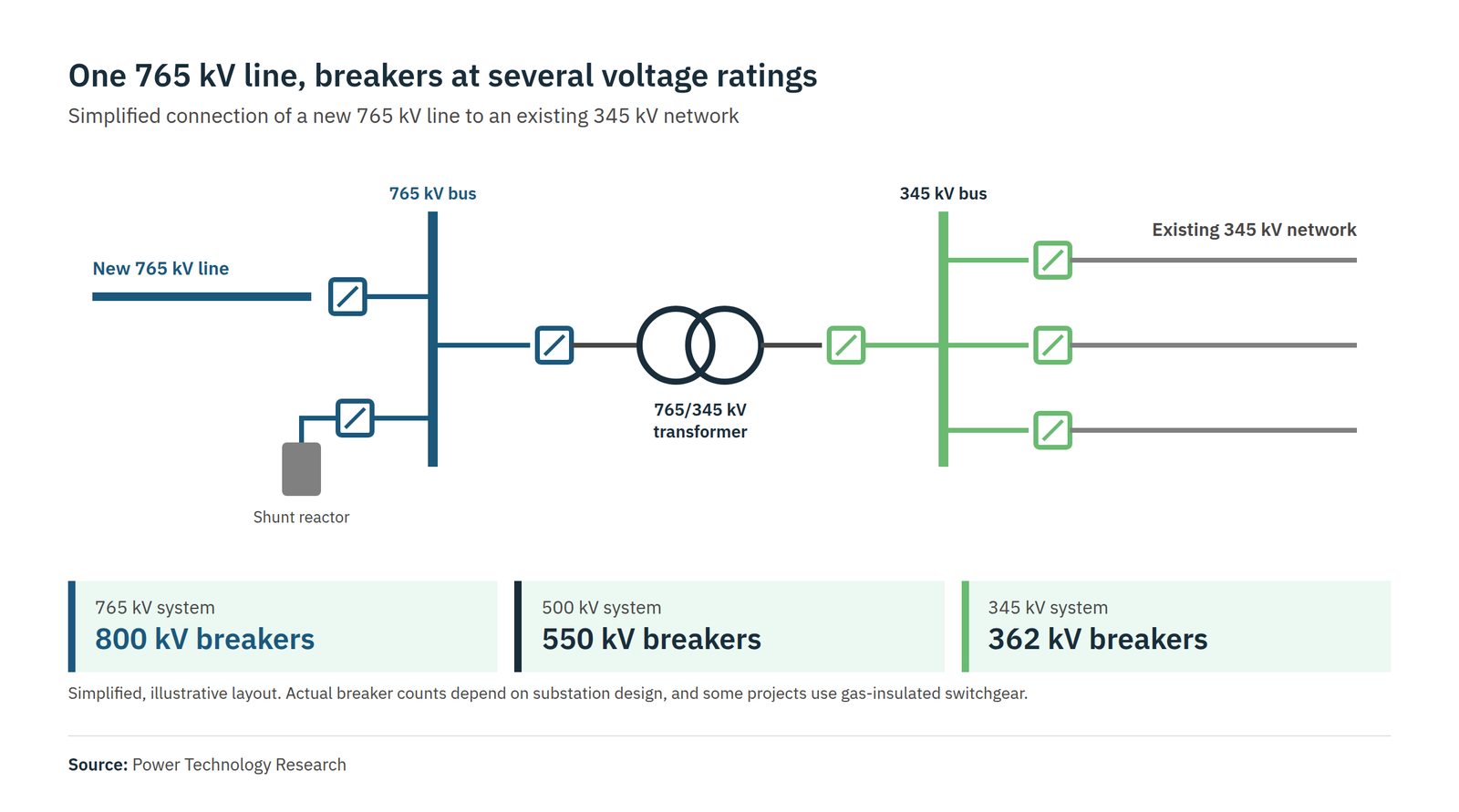
These connections are apparent in the approved project portfolios. MISO’s 765 kV development includes 345 kV facilities needed to integrate the new backbone with the wider system, while PJM’s February 2026 program combines new EHV corridors with upgrades to established substations. PJM’s project documentation also identifies additional 500 kV breakers for transformer connections in selected projects. For OEMs, the relevant opportunity is therefore not limited to the new line’s highest voltage. It also includes the switching and transformation equipment specified at the connection points, although the exact scope will only become clear as individual projects progress through engineering.
U.S. DTCB market outlook: Growth in volume and value
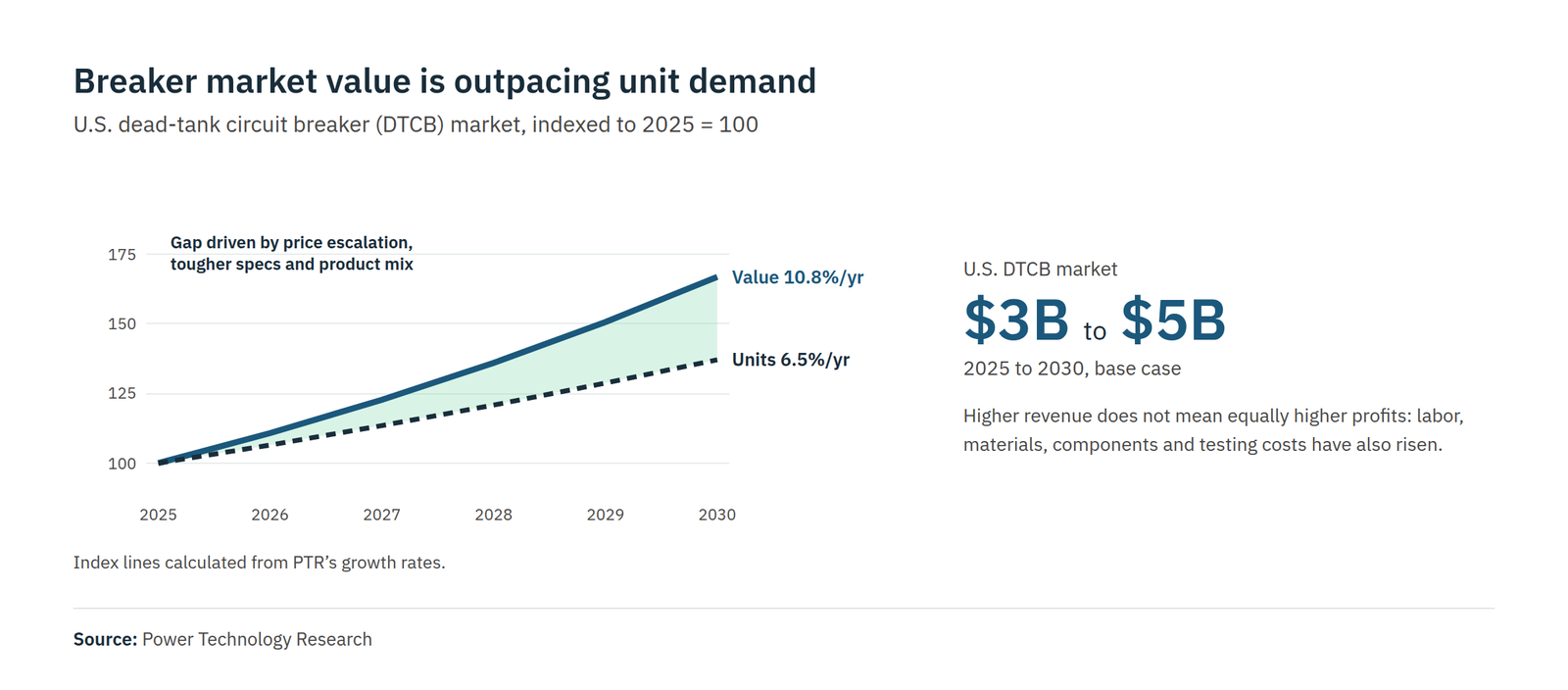
PTR’s U.S. dead-tank circuit breaker (DTCB) assessment estimates that the annual market will increase from approximately $3 billion in 2025 to $5 billion by 2030, representing about 10.8% compound annual revenue growth in the base case. Growth in physical demand is lower, at approximately 6.5% per year over the same period. The difference is significant for manufacturers: equipment-price escalation, more demanding utility specifications, and a gradual shift toward higher-value products are increasing the market’s value faster than the number of breaker positions purchased. Revenue growth should not, however, be interpreted as an equivalent increase in supplier profitability, since labor, materials, components, and testing costs have also risen.
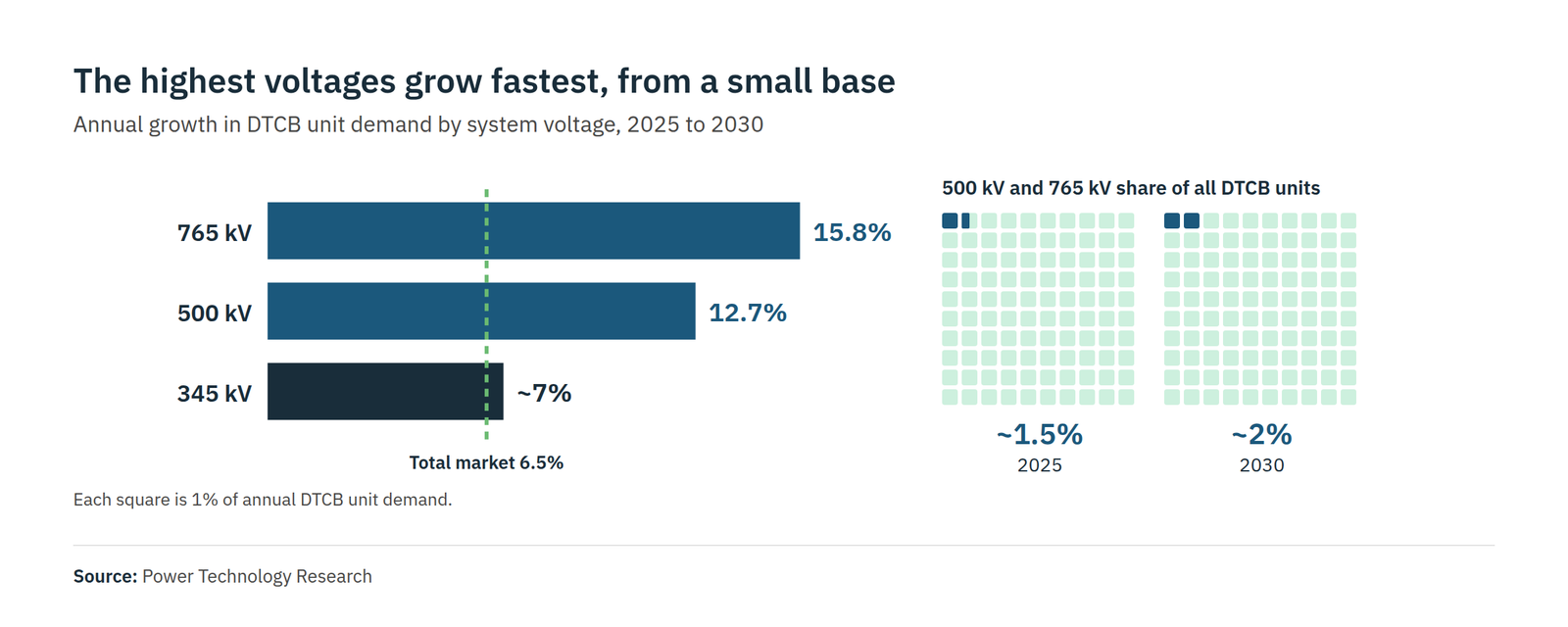
Changes in the voltage mix form one part of this outlook. PTR forecasts annual unit demand associated with 500 kV systems growing by approximately 12.7% between 2025 and 2030, compared with 15.8% at 765 kV and around 7% at 345 kV. Demand at the two highest nominal system voltages is therefore growing faster than the market average, reflecting new EHV projects and a relatively small starting base. Their combined share of annual DTCB unit demand nevertheless remains modest, increasing from approximately 1.5% in 2025 to around 2% in 2030. Higher growth in these segments is important, but it does not displace the much larger existing market.
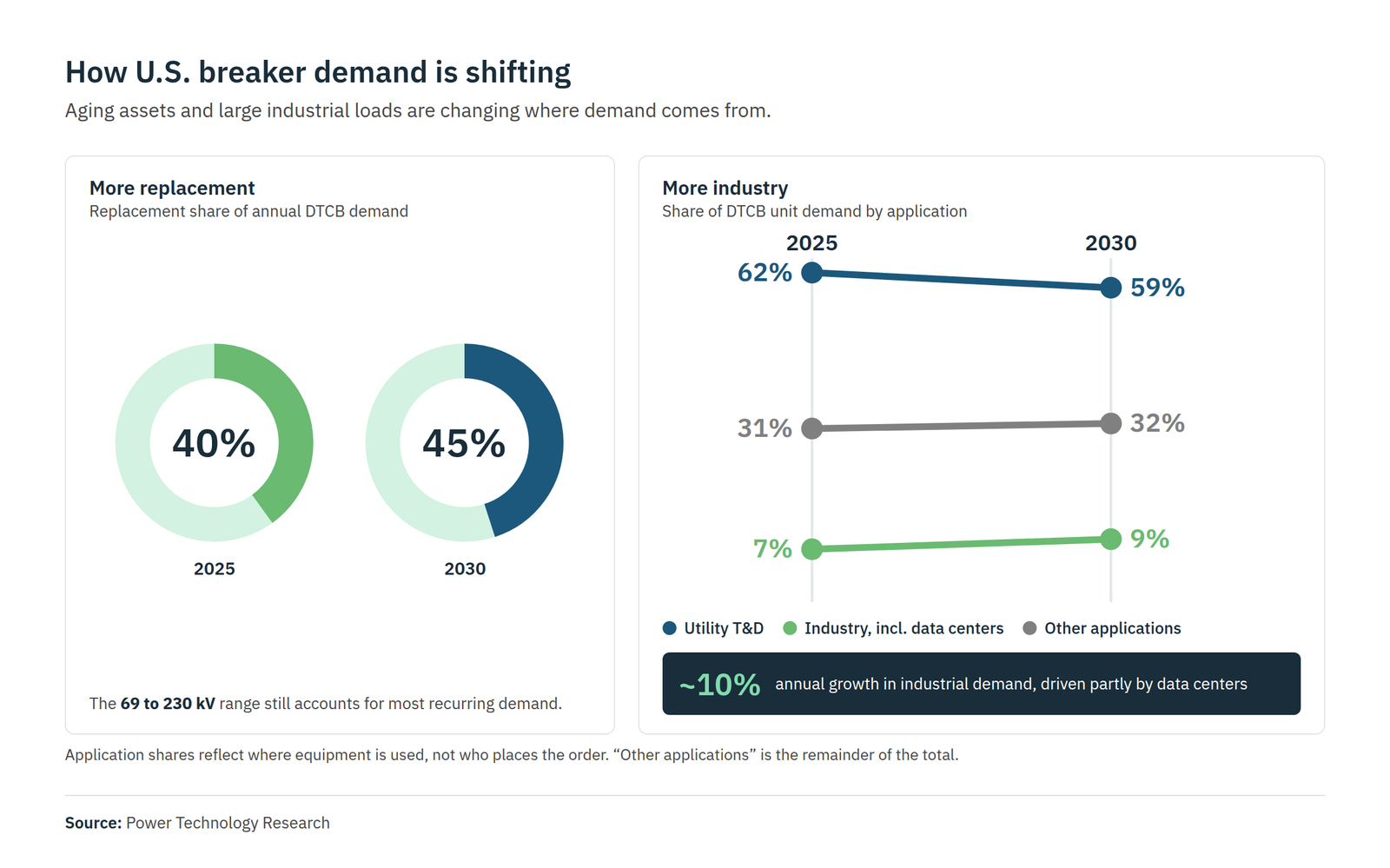
The 69–230 kV range continues to account for most recurring DTCB demand. Utilities operate an extensive installed base at these voltages, and circuit breakers are required for replacement, substation expansion, generation connections, and large industrial receiving stations. The balance of demand is also changing: PTR estimates that replacement demand increases from around 40% of annual DTCB demand in 2025 to 45% by 2030 as aging assets and maintenance considerations become more prominent. New substations and network reinforcement remain substantial sources of business alongside replacement. For suppliers, this means the established product portfolio provides continuity while EHV projects add a smaller, more specialized source of growth.
The differing economics of these products also affect manufacturing decisions. Although EHV breakers account for relatively few annual positions, their higher equipment values and specialized engineering and testing requirements make them important to OEM capacity planning. This is a different business from supplying established voltage classes at higher volumes, with the investment and qualification decisions reflecting that distinction.
What the changing demand mix means for OEMs
Transmission investment is not the only source of changing demand. PTR’s application analysis identifies transmission and distribution utilities as the largest DTCB customers, but forecasts a gradual increase in the contribution of industrial applications. On a physical-demand basis, the utility T&D share moves from approximately 62% in 2025 to 59% in 2030, while industry increases from about 7% to 9%. Industry demand is expected to grow at close to 10% annually, supported in part by data centers, manufacturing facilities, and other electricity-intensive projects needing high-voltage connections. These shares describe the application of the equipment, not necessarily who places the purchase order.
A large data-center or industrial development may require a customer receiving substation, while the serving utility upgrades lines or adds switching and transformer capacity upstream. Different organizations can finance or procure those works, but the utility’s technical requirements frequently continue to govern equipment connected to its network. Manufacturers pursuing utility and private-sector projects therefore need to distinguish the demand originating from a customer development from the procurement and approval arrangements used to deliver it. The point is especially relevant in regions such as Northern Virginia, Central Ohio, and Texas, where large-load connections overlap with major transmission programs.
The opportunity varies by product portfolio rather than simply following the fastest-growing voltage class. Manufacturers already qualified at 800 kV can compete for specialized breaker positions on new 765 kV networks. Suppliers with established 245 kV, 362 kV or 550 kV products may serve connected substations and reinforcement projects, in addition to the larger replacement market. For a manufacturer considering a new platform, the size and timing of accessible projects must be weighed against product development, testing, service capability and the time needed to obtain utility approval. Expanding at a proven voltage class may therefore offer a different near-term opportunity from entering the smaller, project-dependent 800 kV market.
Manufacturing investment and access to the U.S. market
Several manufacturers are increasing U.S. breaker capacity, although new factories and existing-plant expansions are at different stages and cover different equipment ratings. In October 2026, Mitsubishi Electric Power Products (MEPPI) opened its Advanced Switchgear Factory in New Galilee, Pennsylvania, as part of an $86 million investment. Hitachi Energy is expanding its Mount Pleasant operations, including high-voltage breaker production. GE Vernova announced a $138 million expansion at Charleroi in July 2026, while Siemens Energy is constructing a new high-voltage switchgear factory in Pearl, Mississippi. Hyosung HICO and Quanta Services formed a Pennsylvania breaker-manufacturing joint venture with announced capability extending to 800 kV. These milestones show a response to sustained demand but do not establish full output or utility qualification across every advertised product rating.
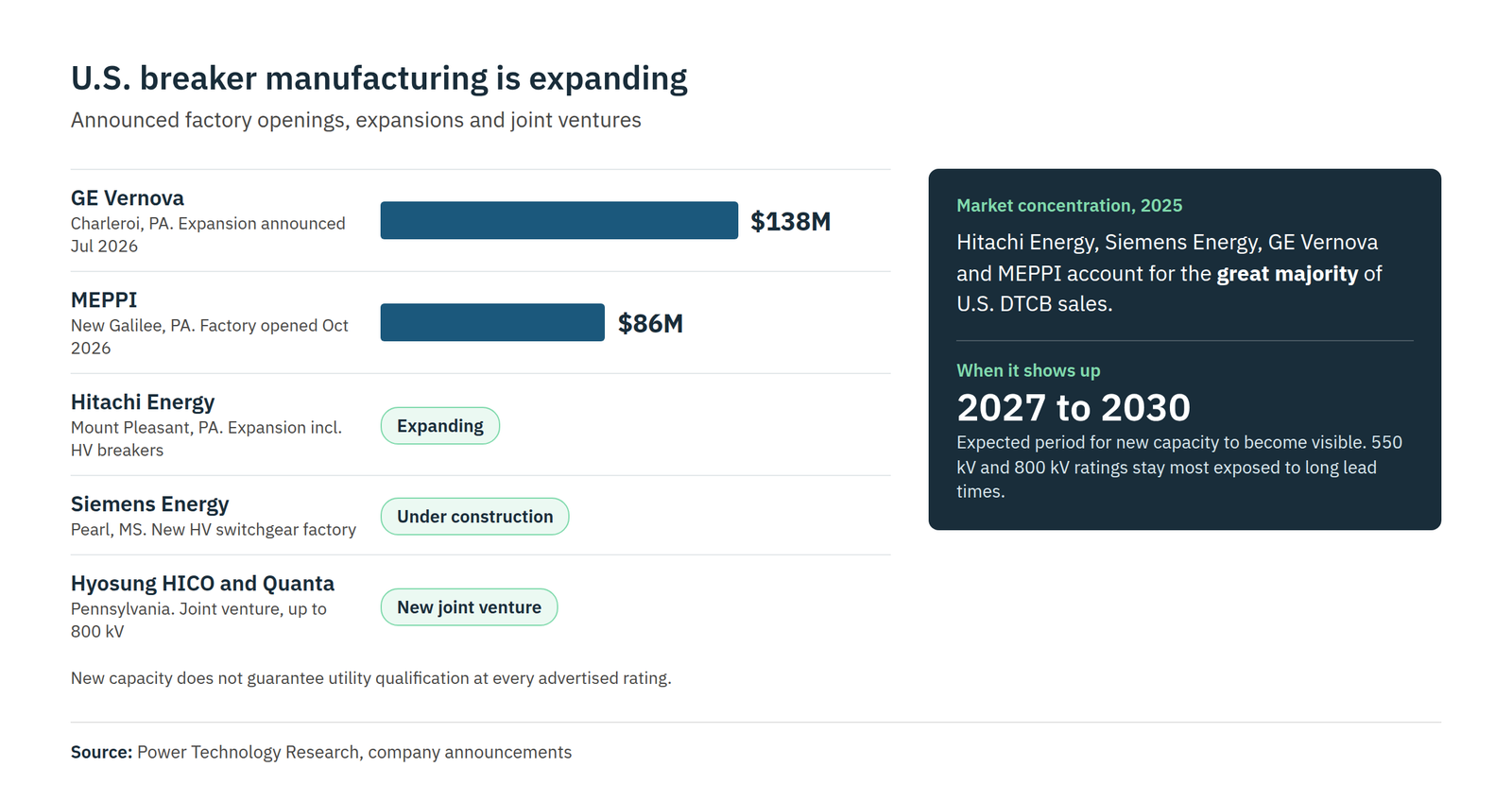
PTR’s supplier assessment points to a concentrated U.S. DTCB market, with Hitachi Energy, Siemens Energy, GE Vernova and MEPPI accounting for the great majority of sales in 2025. Their established product platforms, operating references and service capabilities remain important advantages. New manufacturing investment may give utilities additional sourcing options, but its effect on competition will depend on which products, ratings and factory locations customers actually approve.
The distinction is particularly important at EHV ratings. Breakers at 550 kV and 800 kV require more specialized interrupters, bushings, operating mechanisms, assembly space, and high-voltage testing than standard lower-voltage designs. Capacity additions will therefore improve availability unevenly across the product range. PTR’s research expects the effects of U.S. manufacturing expansion to become more visible during 2027–2030, with the highest ratings remaining more exposed to long lead times and limited test capacity. Additional factory output may relieve part of the backlog without immediately changing procurement conditions for every EHV project.
Utility qualification adds a separate constraint. For expanding OEMs, type testing, factory reviews, operating references and service support remain important conditions for market access.
SF6-free technology and the next generation of EHV projects
SF6-free circuit breakers are becoming a more relevant consideration for manufacturers developing their high-voltage portfolios. Utilities specifying equipment for new transmission substations must consider decades of operating life, including insulation and interruption performance, maintenance practices, and the handling of insulating gases. Alternatives to SF6 can reduce the environmental impact associated with gas leakage and end-of-life handling, but they must meet the same electrical duties and utility reliability requirements as established designs.
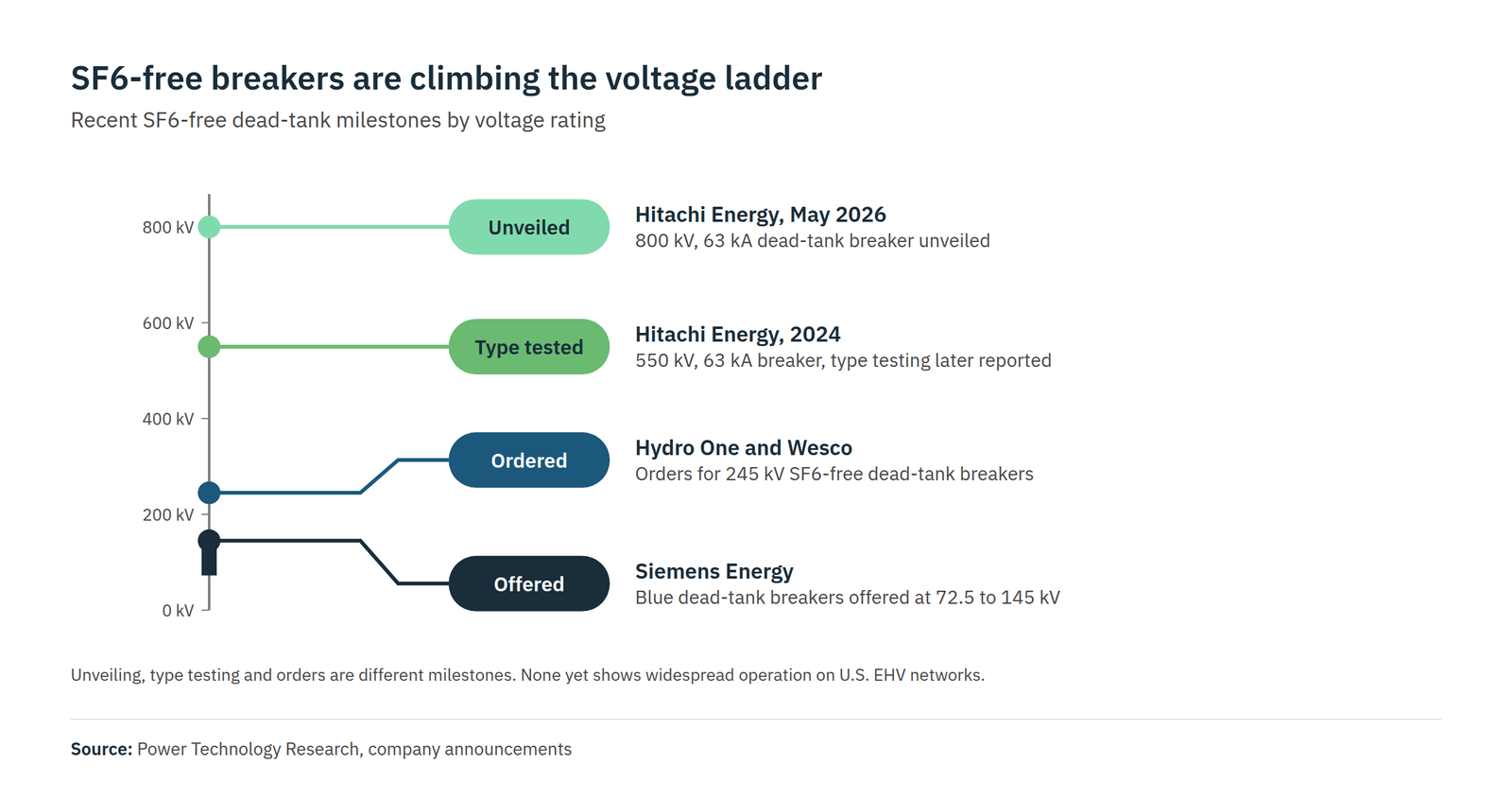
SF6-free development is progressing at several voltage ratings, although the technologies are at different stages of commercial maturity. Hitachi Energy introduced a 550 kV, 63 kA SF6-free circuit breaker in 2024 and subsequently reported successful type testing. In May 2026, it unveiled an 800 kV, 63 kA SF6-free dead-tank breaker relevant to future 765 kV systems. At 245 kV, Hydro One in Canada and Wesco placed orders for SF6-free dead-tank breakers. Siemens Energy also offers SF6-free Blue dead-tank breakers at 72.5–145 kV. These examples should not be interpreted as equivalent evidence of adoption: type testing, a product unveiling and a customer order are different milestones, and orders do not establish widespread operation on U.S. EHV networks.
For OEMs, SF6-free technology offers a potential means of differentiation where utilities place value on reducing lifecycle emissions. The commercial requirement is broader than an alternative insulating medium: the complete breaker must meet the specified switching duties and demonstrate suitable test records, maintenance procedures, field references and service support. Those requirements become particularly demanding at 550 kV and 800 kV, where the operating base for alternative designs is still developing. Conventional SF6 equipment will remain important while utilities assess newer products and build confidence in their long-term performance.
Outlook
The renewed development of 765 kV transmission adds a specialized growth opportunity to a U.S. circuit breaker market still anchored by established voltage classes. PTR’s forecasts indicate that market value is rising faster than the number of physical breaker positions, while new EHV corridors also create requirements at connected substations. The scale of the opportunity will differ by manufacturer, depending on the voltage classes it supplies and the projects for which its products are approved.
The practical challenge for OEMs is aligning product development and factory capacity with the engineering and procurement schedules of individual transmission programs. Some major 765 kV corridors are not expected to enter service until the early 2030s, yet qualification and procurement decisions will take place earlier. Suppliers able to demonstrate reliable delivery, relevant operating references and approved equipment at the required ratings will be better placed to participate. As SF6-free platforms mature, environmental performance may provide another consideration in supplier selection, but it will not replace the established requirements for electrical performance and long-term service.
High Voltage Switchgear Service Overview
The research presented in this article is from PTR's High Voltage Switchgear market research. For information about this service please submit a request shown below.
Europe: +49-89-12250950
Americas: +1 408-604-0522
Japan: +81-80-7808-1378
GCC/Rest of APAC: +971-58-1602441
More About our: High Voltage Switchgear Market Research
Recent Insights
Beyond Main Feeders: The Growing Market for Automated Lateral Protection
Distribution utilities are extending protection and automation beyond main feeders, and automated lateral protection is emerging as a fast-growing new layer of overhead distribution automation.
Built on Dead Tanks: Inside the US Market for Breakers, Transformers, and SF6-Free Switchgear
The US favors dead tank circuit breakers, oil-filled transformers and air-insulated substations. Solar, wind and data centers drive demand, while SF6-free switchgear gains ground slowly.
Powering the Boom: How Renewables and Data Centers Are Lifting Electrical Equipment Markets
Renewables, EV charging and data centers are pushing switchgear, transformer and data center power equipment growth well above historical levels across three regions.
Beyond Main Feeders: The Growing Market for Automated Lateral Protection
Distribution utilities are extending protection and automation beyond main feeders, and automated lateral protection is emerging as a fast-growing new layer of overhead distribution automation.
Built on Dead Tanks: Inside the US Market for Breakers, Transformers, and SF6-Free Switchgear
The US favors dead tank circuit breakers, oil-filled transformers and air-insulated substations. Solar, wind and data centers drive demand, while SF6-free switchgear gains ground slowly.
Powering the Boom: How Renewables and Data Centers Are Lifting Electrical Equipment Markets
Renewables, EV charging and data centers are pushing switchgear, transformer and data center power equipment growth well above historical levels across three regions.
Reclosers and Overhead Switches: A Steady, Reliability-Driven Market Where Execution Wins
A PTR study of medium-voltage overhead switches across 20 countries found that utilities buy reclosers to meet reliability pressure, and that winning their business takes more than a good product.