
Distribution utilities are extending protection and automation beyond substations and main feeders. Drawing on PTR’s medium-voltage overhead-switch research, this article examines why laterals and sub-laterals are attracting greater attention, how intelligent protection changes the economics of electricity restoration after a fault, and where the next market opportunities are developing.
Introduction
For decades, distribution utilities have used automatic reclosers on main feeders while relying on simpler protective equipment further downstream. A main-feeder fault can interrupt a large number of customers, making the investment in fault interruption, reclosing and remote control relatively easy to justify. Laterals and sub-laterals present a different problem. They are numerous, vary considerably in length and loading, and often serve smaller customer groups. Conventional fuses have therefore remained common at these locations, despite the disruption caused when a fuse operates for a temporary fault.
The prospect of extending automation into these smaller branches deserves greater attention as utilities invest in reliability and more active distribution networks. Compact pole-mounted lateral devices, including single-phase fault interrupters with reclosing capability, can interrupt temporary faults and attempt to restore supply on selected branches without a crew visit to replace a fuse. PTR’s medium-voltage overhead-switch research indicates that the established recloser market will remain substantially larger, but demand for automated lateral protection is growing faster. The opportunity is to extend automatic restoration and, where useful, fault information into the parts of the distribution network that have historically depended on manual intervention.
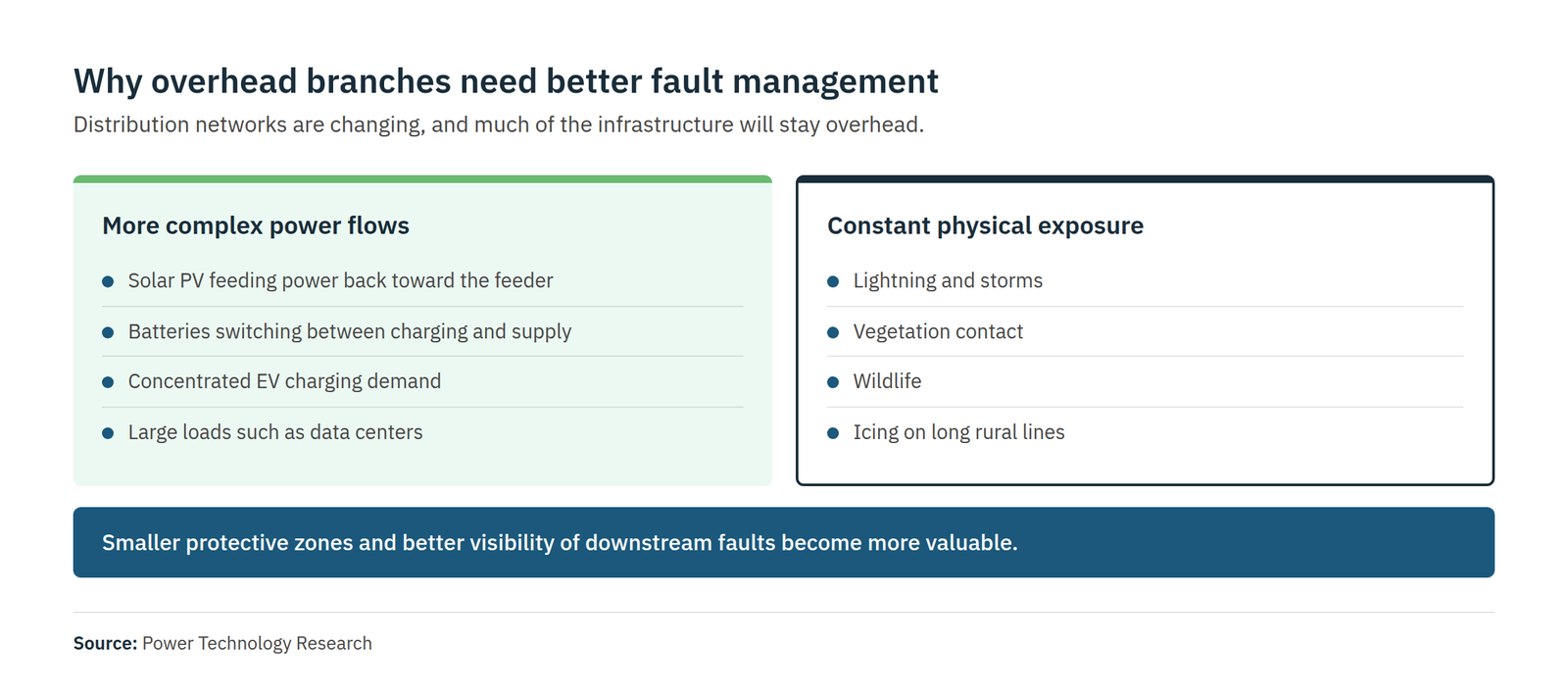
Distribution networks are changing, but much of the infrastructure will remain overhead
The traditional radial distribution model assumed electricity would move principally from a substation toward customers. Solar PV can now inject power back toward the feeder, batteries can alternate between charging and generation, and EV charging introduces demand that may be highly concentrated at particular locations. Some industrial and commercial connections, including data centers at suitable distribution voltage levels, add further localized loading. The IEA’s 2026 assessment of grid monitoring and control describes the resulting shift from relatively static, unidirectional distribution networks toward systems requiring more frequent monitoring and active operation.
Changing power flows can affect voltage control and protection coordination. Inverter-based resources may contribute fault current differently from conventional sources, and power-electronic loads introduce separate power-quality considerations. Reclosing equipment does not solve voltage, harmonic or capacity problems; its contribution is to the fault-management side of distribution operation. As utilities seek more precise monitoring and control of increasingly complex networks, smaller protective zones and better knowledge of downstream events become more valuable.
Physical exposure provides another reason for additional investment. Overhead circuits remain vulnerable to lightning, vegetation, wildlife, storms and icing, particularly on lengthy rural networks. Undergrounding reduces exposure to several of these hazards and can be justified for critical corridors or dense urban areas. The US Department of Energy’s undergrounding investment guide, however, identifies higher construction costs and greater difficulty accessing and repairing underground faults. For extensive rural networks, utilities will continue to combine selective undergrounding with vegetation management, network hardening, sectionalization and automatic restoration on the overhead infrastructure that remains.
Why laterals and sub-laterals are the next practical locations for automation
A main feeder can supply multiple laterals, which may themselves branch into smaller sub-laterals. The number of potential protection points increases considerably beyond the feeder backbone. Their characteristics are far from uniform: one lateral may serve a few remote customers across several kilometers, while another carries a substantial commercial or agricultural load. PTR’s country-level research identifies these network differences as a major reason that the opportunity for lateral protection cannot be inferred from national grid expenditure alone. A branch’s function and the consequences of its outages matter more than its existence on a network map.
Conventional fuse protection is effective because it is simple, economical and familiar to utility crews. When a permanent fault occurs on a downstream branch, the fuse can isolate that section while leaving the rest of the feeder energized. The disadvantage arises with temporary faults caused by vegetation contact, lightning or wildlife. Once the fuse link melts, customers generally remain disconnected until a crew travels to the location, inspects the circuit and replaces the link. Where travel distances are long, the restoration effort can be disproportionate to the size of the branch.
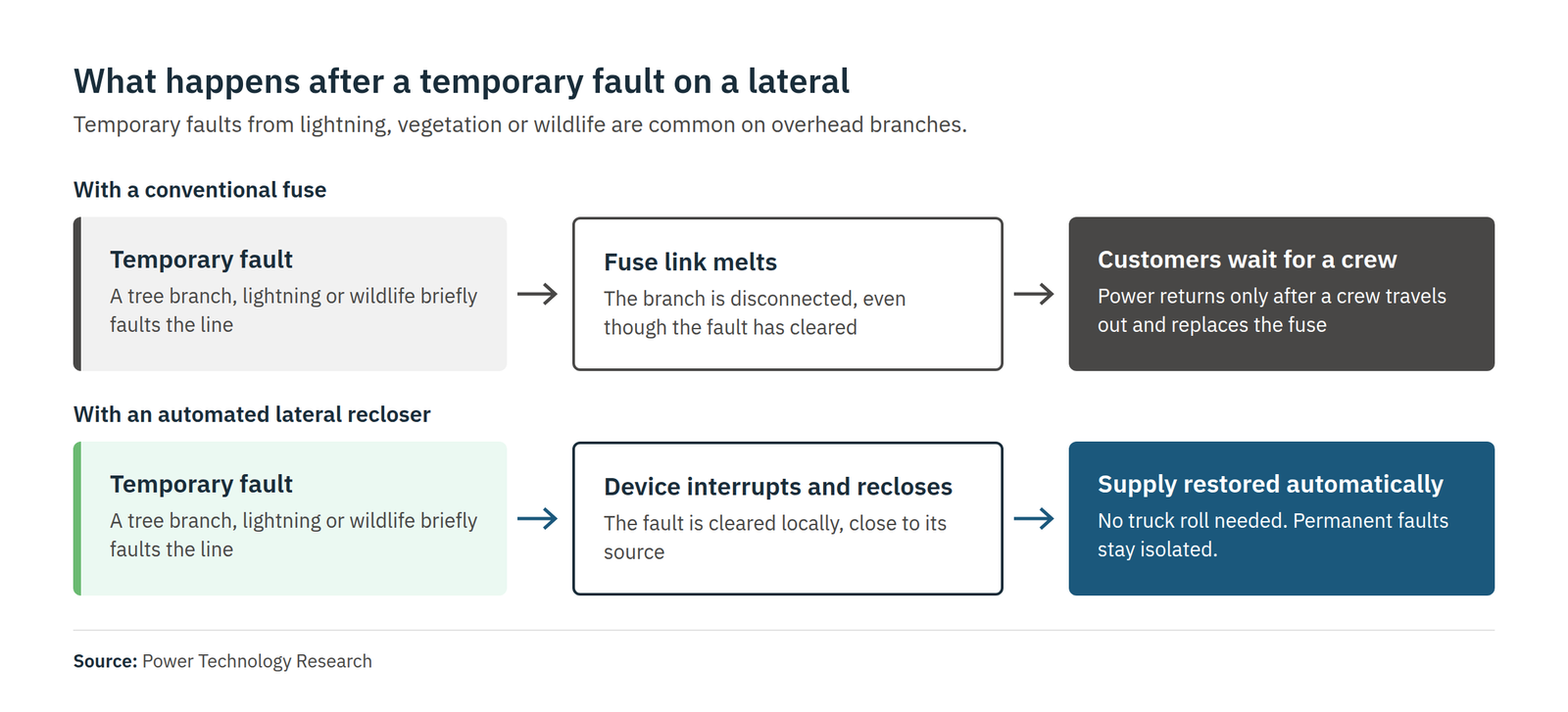
Feeder-level fuse-saving offers one established response: an upstream recloser operates rapidly to clear a temporary fault before the branch fuse melts. That arrangement can preserve the fuse but may momentarily interrupt a wider group of customers. Installing automatic interruption and reclosing on an appropriate lateral moves the restoration attempt closer to the source of the fault. Temporary faults can be cleared without a sustained fuse-related outage, while permanent faults are left isolated under the coordinated protection scheme. Main-feeder reclosers continue to protect larger network sections; lateral equipment extends automatic fault management to locations below them.
The approach can serve single-phase laterals as well as selected three-phase branches, provided the equipment and protection scheme suit the circuit. Compact single-phase automatic reclosers are one common implementation, sometimes used in coordinated multi-phase arrangements. Siemens Fusesaver and S&C’s TripSaver II illustrate commercially available equipment designed for downstream overhead applications. What matters to the market is less the product name than the ability to add local reclosing at an appropriate cost and with reliable coordination with upstream protection.
From simple protection to more useful operating information
An electronic lateral device may bring additional functions beyond automatic restoration. Selectable protection characteristics and operation records can help engineers investigate repeated faults and adjust coordination settings. Some designs can provide current measurements, fault indications or communications interfaces that allow operators to view branch status remotely. These capabilities are useful on rural circuits where the utility may otherwise receive little operating information between inspections and customer outage reports.
The ability to gather information also changes how utilities can plan subsequent investments. Repeated temporary operations on the same spur can reveal a need for vegetation work, equipment inspection or an upgraded protection arrangement. Remote status can help dispatchers identify which branch remains disconnected, reducing unnecessary fault-searching. Not every installation needs continuous communications: autonomous reclosing may deliver most of the value on one branch, while another may justify monitored operation because access is difficult, outages are recurrent or customers are more interruption-sensitive.
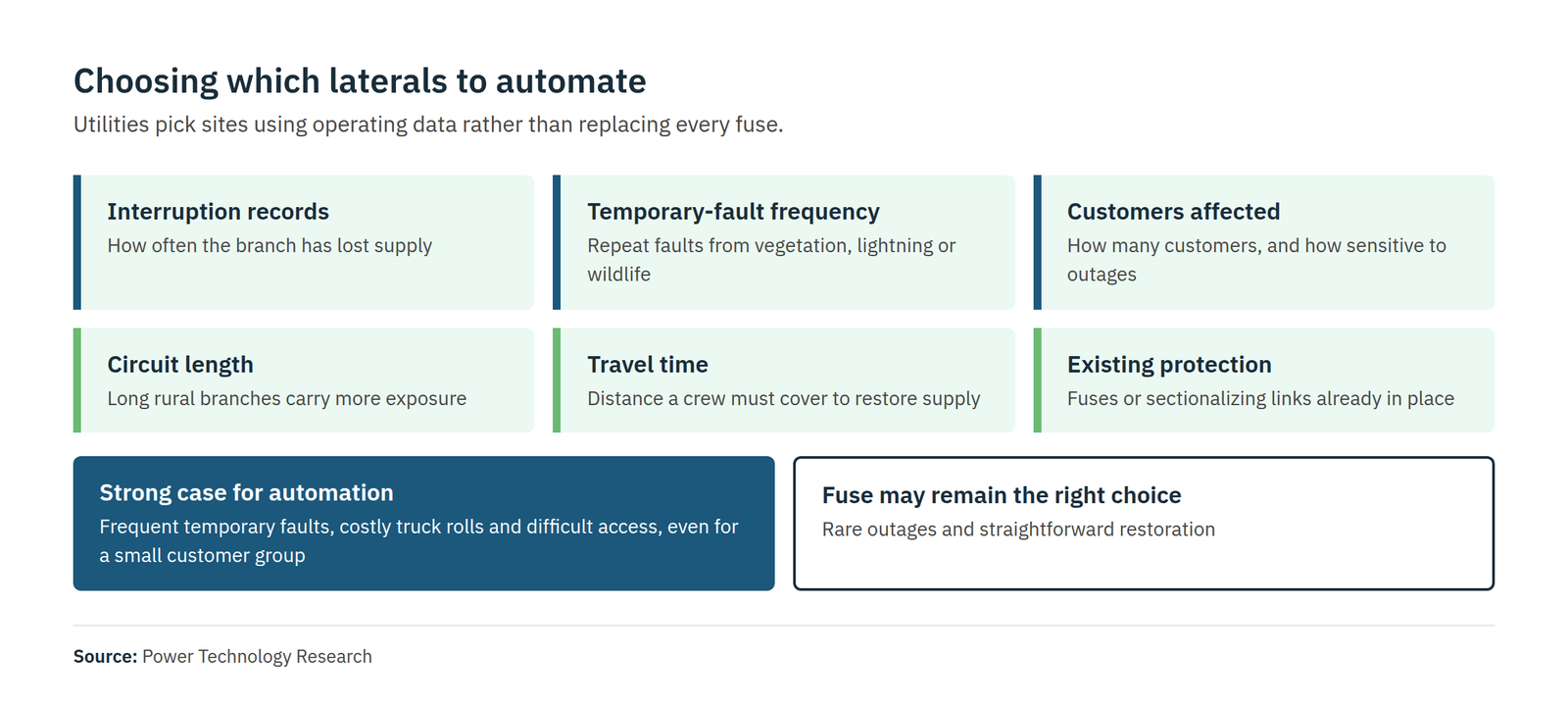
The important commercial decision is therefore where to install the additional capability. A branch with frequent temporary faults, costly truck rolls and difficult access can justify automation even if it serves relatively few customers. Where outages are rare and restoration is straightforward, the existing fuse may remain entirely satisfactory. Utilities can select sites using interruption records, temporary-fault frequency, customers affected, circuit length, travel time and the protection already installed, rather than follow a policy of replacing fuses across the network.
What actual utility programs reveal
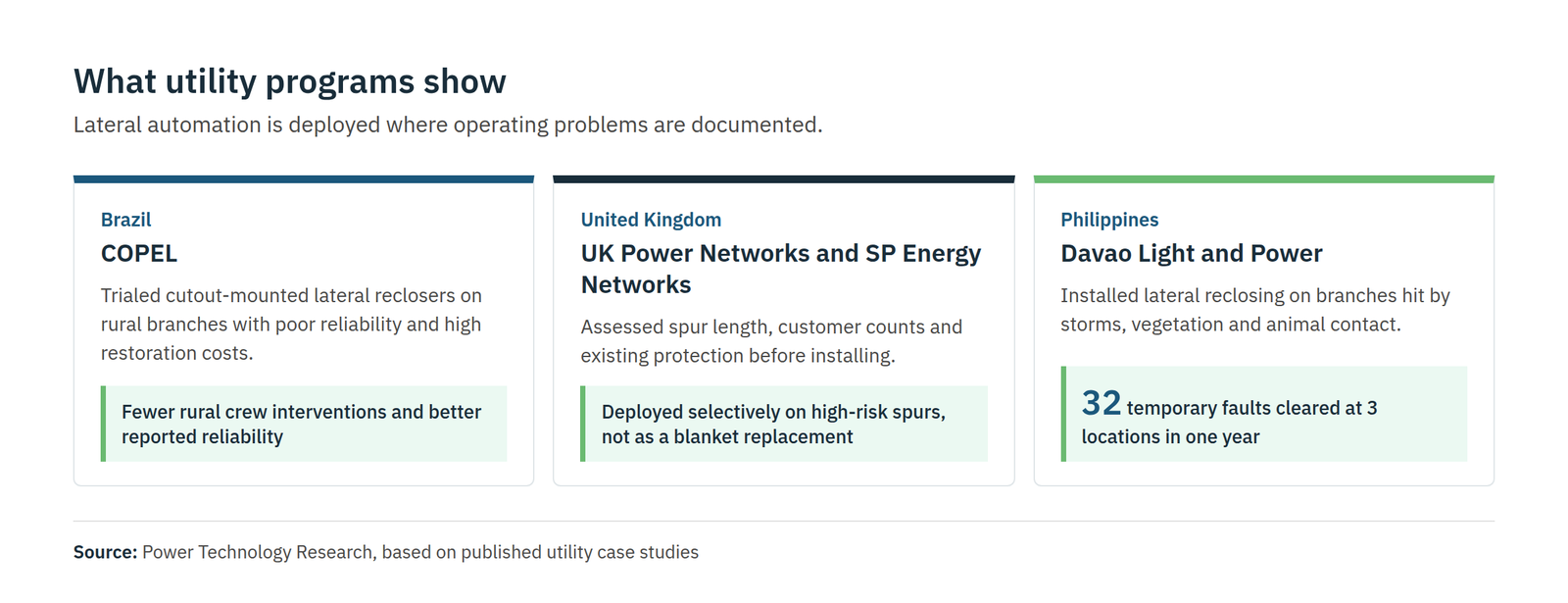
Brazil provides an established example of extending reclosing into rural branches. Utility COPEL evaluated cutout-mounted lateral reclosers in locations where interruption performance and restoration costs were concerns, conducting trials before wider implementation. According to S&C Electric’s COPEL case study, the initial deployments reduced rural crew interventions and helped the utility improve its reported reliability performance. The deployment was driven by documented operating problems and utility reliability requirements, rather than a decision to exchange every fuse for a more expensive device.
The UK shows why established protection practices influence the market differently. UK Power Networks’ Better Spur Protection project investigated compact lateral protection on feeders with different existing levels of automation. One network area already had extensive use of automatic sectionalizing links, while another offered opportunities on feeders with fewer such devices. The project assessed spur length, customer counts, installed protection and the value of fault and load information. In a separate UK investigation, SP Energy Networks’ review of automatic sectionalizing links similarly found that single-phase reclosers were being deployed selectively on spurs with high transient-fault exposure, long rural circuits or substantial customer impacts, rather than as a general replacement for established protection.
More recent experience in Asia Pacific shows how the application can develop alongside network expansion. In the Philippines, Davao Light and Power Company introduced lateral reclosing on branches affected by storms, vegetation and animal contact. A case history published in June 2026 reports that the utility identified three troublesome locations where the devices cleared 32 temporary faults within one year that might otherwise have caused sustained interruptions. The utility subsequently expanded deployment as part of a wider reliability program that also included feeder reinforcement and other network measures. This is an example of lateral automation supplementing, rather than replacing, broader distribution investment.
Regional market potential depends on more than overhead line length
PTR’s market study shows a sharp difference between the established recloser market and the much smaller market for automated lateral fault interruption. In PTR’s 2024 estimates, the Americas account for roughly three-quarters of annual lateral-device installations in the studied markets, while Europe accounts for just under one-quarter. Brazil is particularly important in the Americas, with established demand also identified in Canada and Mexico. The combination of long overhead networks, difficult restoration logistics and utility experience provides opportunities to extend existing programs to additional branches. The COPEL experience illustrates why measurable reliability improvements can turn a targeted application into repeated procurement.
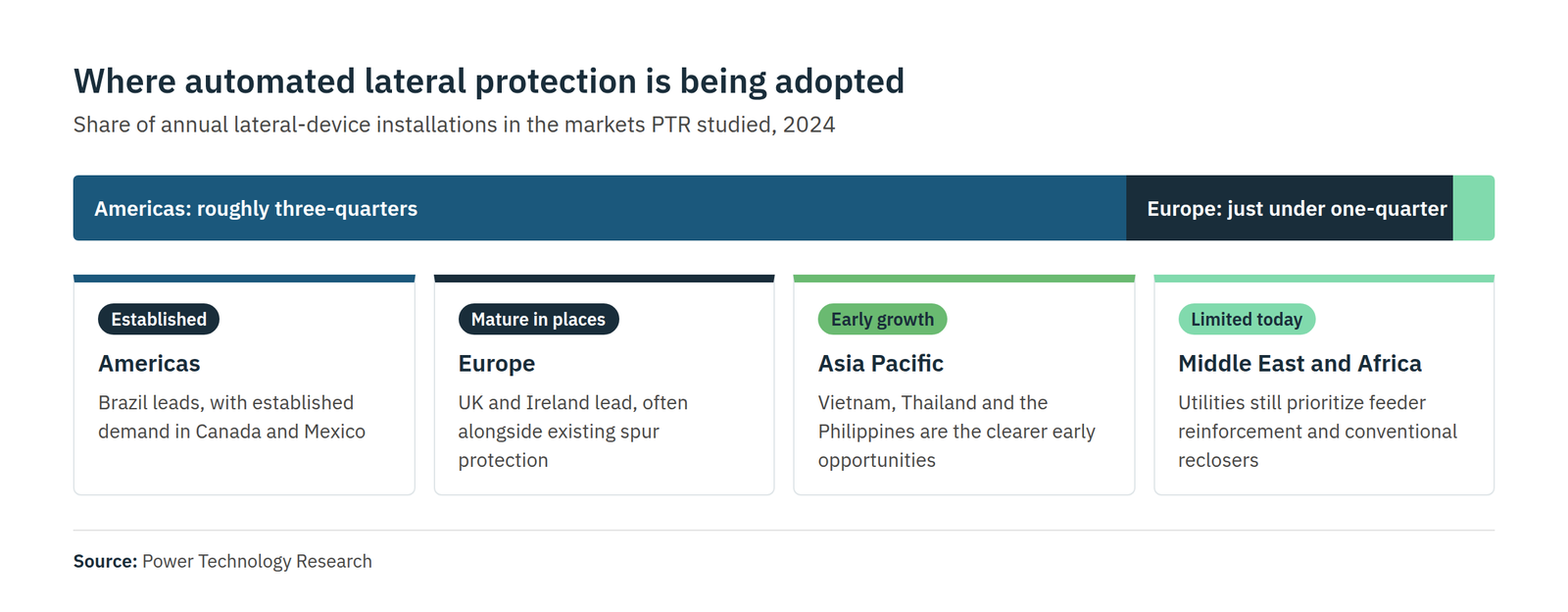
In Europe, the UK and Ireland stand out for comparatively mature use of downstream automatic protection, but an existing protection base can change the nature of the opportunity. Utilities with automatic sectionalizing links or other established spur-protection arrangements are not starting from the same position as a network dependent primarily on manual fuse replacement. Market development may involve selective replacement, complementing an existing arrangement with more capable local reclosing or improving fault visibility. This helps explain why equipment adoption cannot be ranked simply by how extensively a country uses conventional fuses.
Asia Pacific represents substantial longer-term potential because many countries have extensive overhead networks and continue to add feeders and customer connections. PTR identifies Vietnam, Thailand and the Philippines among the clearer early growth opportunities for automated lateral equipment, while much of the regional investment still prioritizes conventional reclosers and feeder-level protection. The Davao Light example demonstrates a practical starting point: identify circuits with frequent temporary outages, validate the protection arrangement in service and then extend installations to comparable locations. India and other large distribution markets may have sizable branch networks, but near-term adoption depends on individual utility priorities, technical specifications and the economics of automation.
In the Middle East and Africa, PTR finds comparatively limited current adoption of compact automated lateral protection. Grid expansion and reliability programs vary substantially between countries, and utilities often prioritize feeder reinforcement, conventional reclosers and higher-impact switching points. The opportunity may develop as those networks acquire more automation experience and begin addressing interruptions farther downstream, although the timing will depend on local operating needs and demonstrated performance rather than broad regional assumptions.
Market outlook: A new layer of overhead distribution automation
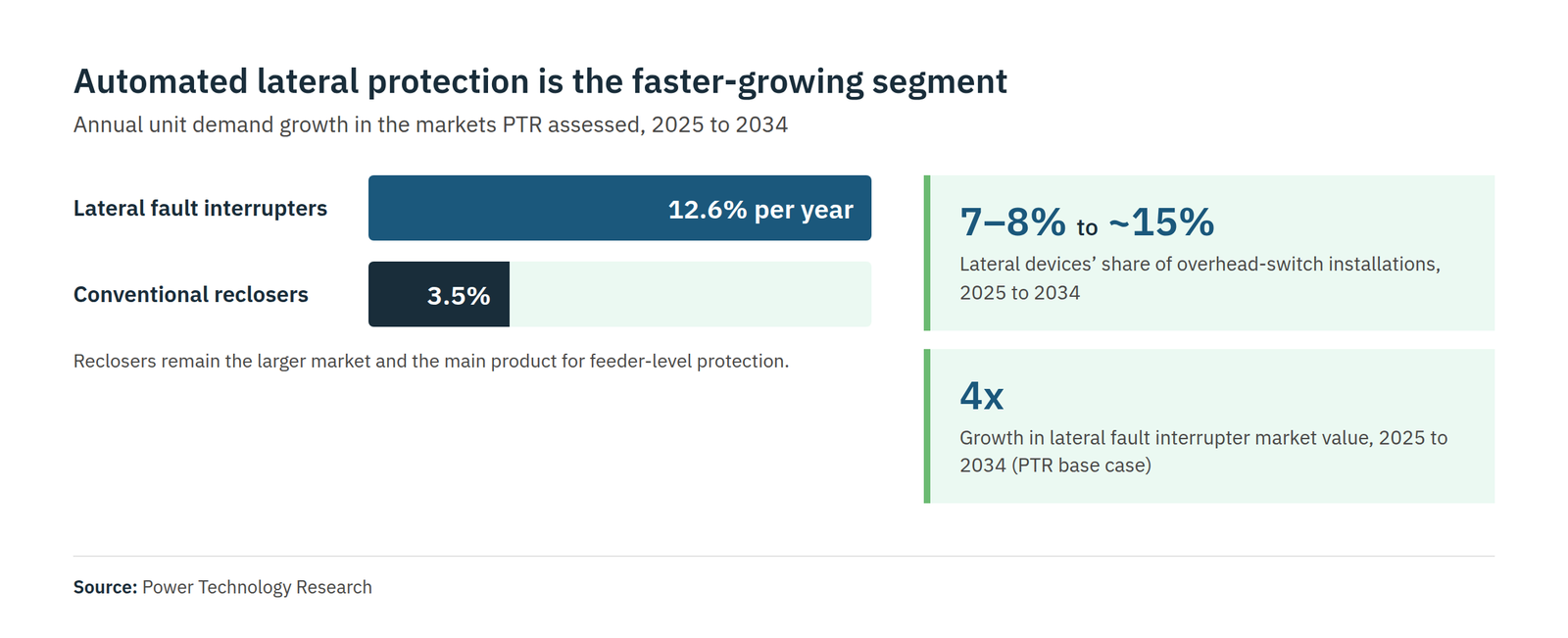
PTR expects annual unit demand for conventional reclosers in the markets assessed to grow by approximately 3.5% per year between 2025 and 2034, compared with approximately 12.6% for lateral fault interrupters. In market-value terms, PTR’s base-case estimate for lateral fault interrupters rises fourfold, reflecting the category’s smaller starting base and the extension of automatic fault management into downstream applications where it has historically been less common. Reclosers remain the principal product category for feeder-level protection. Within the combined annual overhead-switch market assessed, the lateral fault interrupter category is expected to rise from approximately 7–8% of equipment installations in 2025 to about 15% in 2034, reflecting a broader range of automated protection locations rather than replacement of feeder reclosers.
Growth is likely to come from several forms of deployment. Utilities with established programs can extend automation to additional branches showing similar outage characteristics. Other utilities may begin with small trials, adding automated protection to recurrent problem spurs before changing their standard designs. New rural feeders and network extensions also provide opportunities to consider local reclosing from the outset, while optional event information and remote monitoring create additional value in locations with limited visibility. Each pathway depends on the local protection strategy, but together they expand demand beyond the conventional feeder backbone.
Conclusion
The next stage of overhead distribution automation will be decided increasingly at the branch level. On laterals with repeated temporary faults, lengthy restoration journeys or interruption-sensitive customers, compact automated protection can reduce sustained outages and provide operating information that conventional fuses cannot. In many other locations, existing fuse or sectionalizing arrangements will continue to serve the network effectively. Utilities are therefore likely to expand automation through selected installations supported by fault records, customer exposure and restoration economics, rather than apply the same equipment configuration to every spur.
PTR’s regional findings show why the commercial opportunity is not proportional to overhead line length alone. It develops differently where utilities have established lateral-reclosing programs, where alternative spur-protection arrangements are already widespread, and where distribution investment is still concentrated on feeder reinforcement. For manufacturers, understanding those local protection practices and identifying repeatable branch-level applications will determine how much of the market potential becomes actual demand.
Medium Voltage Switchgear Service Overview
The research presented in this article is from PTR's Medium Voltage Switchgear market research. For information about this service please submit a request shown below.
Europe: +49-89-12250950
Americas: +1 408-604-0522
Japan: +81-80-7808-1378
GCC/Rest of APAC: +971-58-1602441
More About our: Medium Voltage Switchgear Market Analysis
Recent Insights
The Return of 765 kV Transmission: Strategic Opportunities for Circuit Breaker Manufacturers
Renewed US investment in 500 kV and 765 kV transmission is creating specialized circuit breaker requirements and reshaping the dead tank breaker market for OEMs.
Built on Dead Tanks: Inside the US Market for Breakers, Transformers, and SF6-Free Switchgear
The US favors dead tank circuit breakers, oil-filled transformers and air-insulated substations. Solar, wind and data centers drive demand, while SF6-free switchgear gains ground slowly.
Powering the Boom: How Renewables and Data Centers Are Lifting Electrical Equipment Markets
Renewables, EV charging and data centers are pushing switchgear, transformer and data center power equipment growth well above historical levels across three regions.
The Return of 765 kV Transmission: Strategic Opportunities for Circuit Breaker Manufacturers
Renewed US investment in 500 kV and 765 kV transmission is creating specialized circuit breaker requirements and reshaping the dead tank breaker market for OEMs.
Built on Dead Tanks: Inside the US Market for Breakers, Transformers, and SF6-Free Switchgear
The US favors dead tank circuit breakers, oil-filled transformers and air-insulated substations. Solar, wind and data centers drive demand, while SF6-free switchgear gains ground slowly.
Powering the Boom: How Renewables and Data Centers Are Lifting Electrical Equipment Markets
Renewables, EV charging and data centers are pushing switchgear, transformer and data center power equipment growth well above historical levels across three regions.
Reclosers and Overhead Switches: A Steady, Reliability-Driven Market Where Execution Wins
A PTR study of medium-voltage overhead switches across 20 countries found that utilities buy reclosers to meet reliability pressure, and that winning their business takes more than a good product.