
As electricity networks expand and reliability requirements increase, the technologies protecting them are changing. Drawing on PTR’s market research and developments in insulation engineering, a recent research endeavor examined how composite materials, surge arrester monitoring, and insulation coordination are influencing equipment selection and maintenance.
Introduction
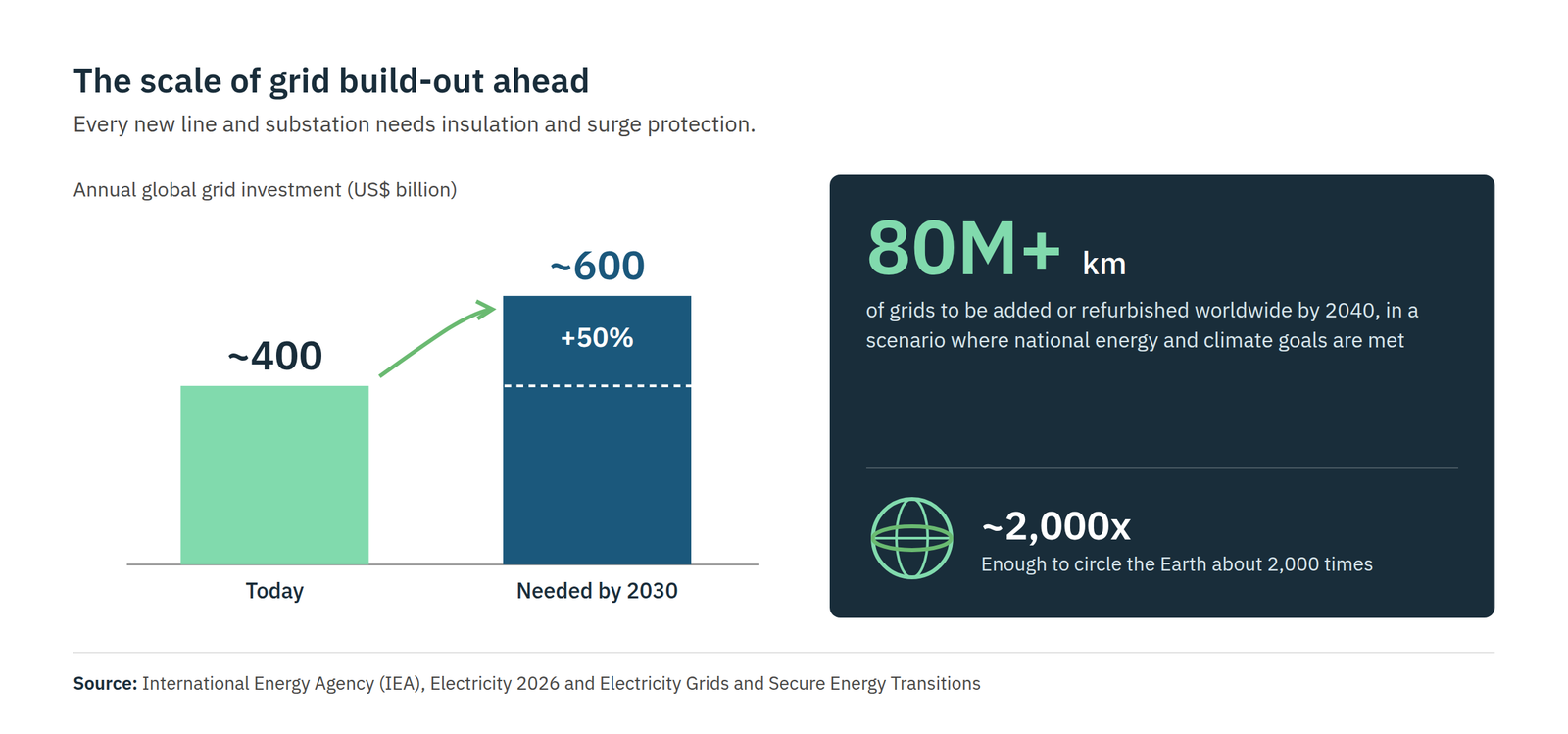
Electricity networks are expanding to accommodate renewable generation, electrification, and growing power demand from industries and data centers. At the same time, utilities are upgrading aging infrastructure and reinforcing existing transmission and distribution systems. According to the IEA’s Electricity 2026 report, annual global grid investment is around US$400 billion and would need to increase by approximately 50% by 2030 to meet projected electricity demand.
While transformers, switchgear, and transmission lines often receive the greatest attention, network reliability also depends on smaller components. Insulators provide electrical separation and mechanical support, while surge arresters protect equipment and insulation systems against transient overvoltages. Both technologies are well established, but developments in materials, testing, monitoring, and protection engineering are influencing how utilities select and maintain them.
Where insulators and surge arresters work together: Overhead-line protection
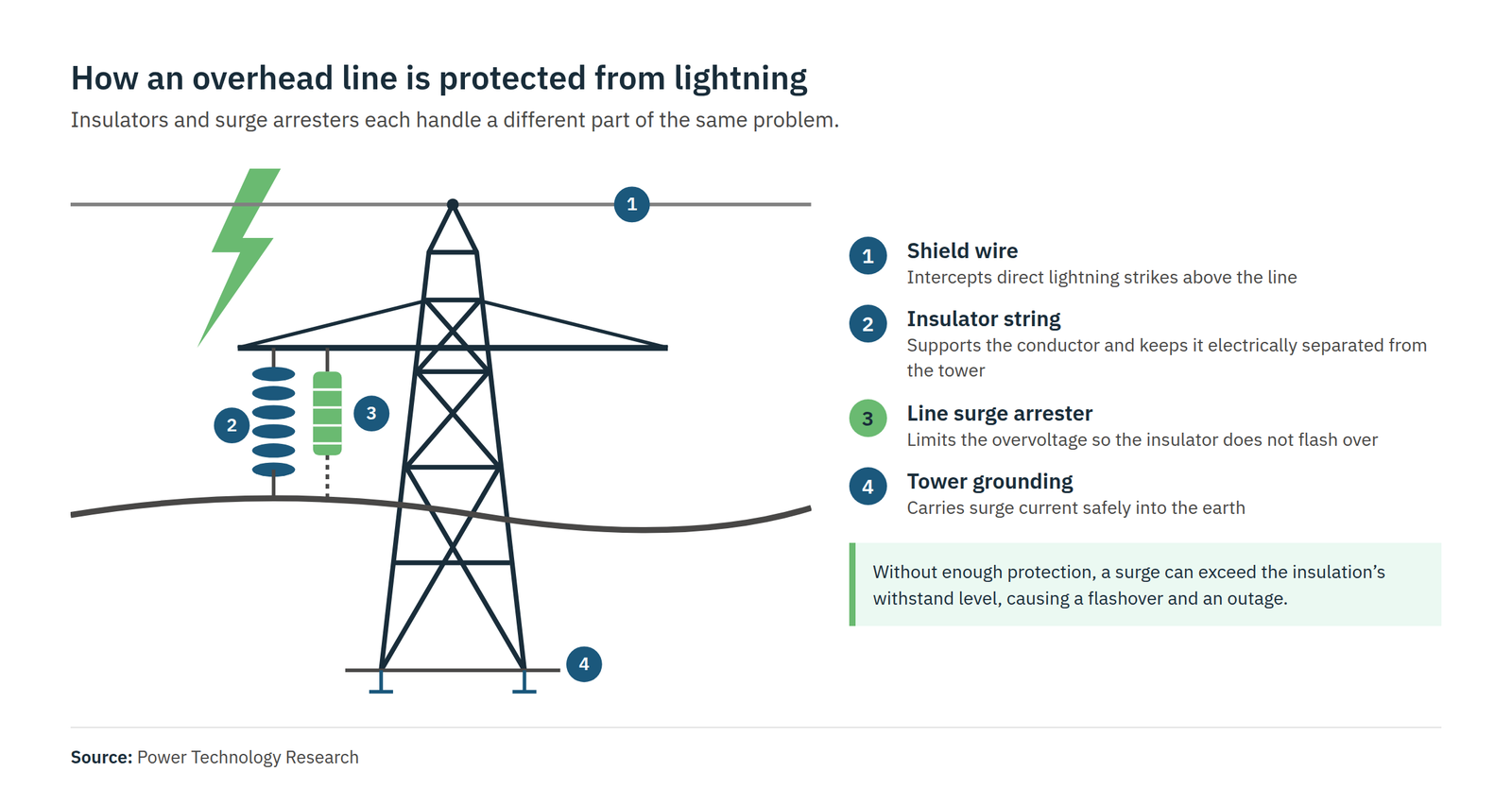
Consider a lightning strike affecting an overhead transmission line. The resulting transient overvoltage can exceed the insulation’s impulse withstand capability, potentially causing a flashover between an energized conductor and a grounded structure. This may lead to a fault and an interruption of electricity supply.
Insulators and surge arresters address different aspects of this problem. Insulators maintain electrical separation while supporting conductors and withstanding mechanical loads. Surge arresters limit transient overvoltages, reducing the risk of insulation flashover and damage to protected equipment.
Lightning is not the only source of electrical stress. Switching operations, line energization, and fault clearing can produce transient overvoltages, while certain earth faults may cause temporary voltage rises on unfaulted phases. These conditions must be considered during insulation coordination, which involves selecting equipment dielectric strength in relation to expected voltages and overvoltages, the service environment, and available protective devices.
Overhead shield wires, tower grounding, and insulation design remain important elements of lightning protection. Where additional protection is needed, utilities may use line surge arresters. Non-gapped line arresters (NGLAs) are connected directly to the energized system, while externally gapped line arresters (EGLAs) use a series air gap that separates the metal-oxide element from the conductor during normal operation. Under specified lightning conditions, the EGLA gap operates to protect the associated insulator assembly.
IEC 60099-8 addresses EGLAs intended for lightning-related protection, while CIGRE’s Technical Brochure 855 examines the effectiveness of line surge arresters under different network conditions.
PTR’s application-level research also highlights that protection requirements differ according to lightning exposure, grounding conditions, critical structures, and utility practices. Arresters may be installed selectively rather than at every tower, with engineering studies helping determine where additional protection provides the greatest benefit.
This coordinated approach illustrates how improvements in network reliability depend on equipment selection and system-level engineering rather than individual components alone.
Insulator technology: Beyond the transition to composites
Porcelain and glass have supported electrical networks for decades and remain important in transmission, distribution, and substation applications. Composite insulators offer alternative performance characteristics, particularly where weight, installation requirements, and environmental exposure influence material selection.
A typical composite long-rod insulator consists of a fiber-reinforced polymer core, a polymeric housing, and metallic end fittings. Compared with many equivalent ceramic designs, composite insulators are lighter, simplifying transportation and installation. Silicone rubber housings also provide advantages under wet and polluted conditions.
Salt, dust, and industrial deposits can become conductive when wet, increasing surface leakage current and the risk of flashover. The hydrophobic properties of silicone rubber help limit continuous water-film formation, while certain formulations can transfer hydrophobicity to contamination deposited on the surface.
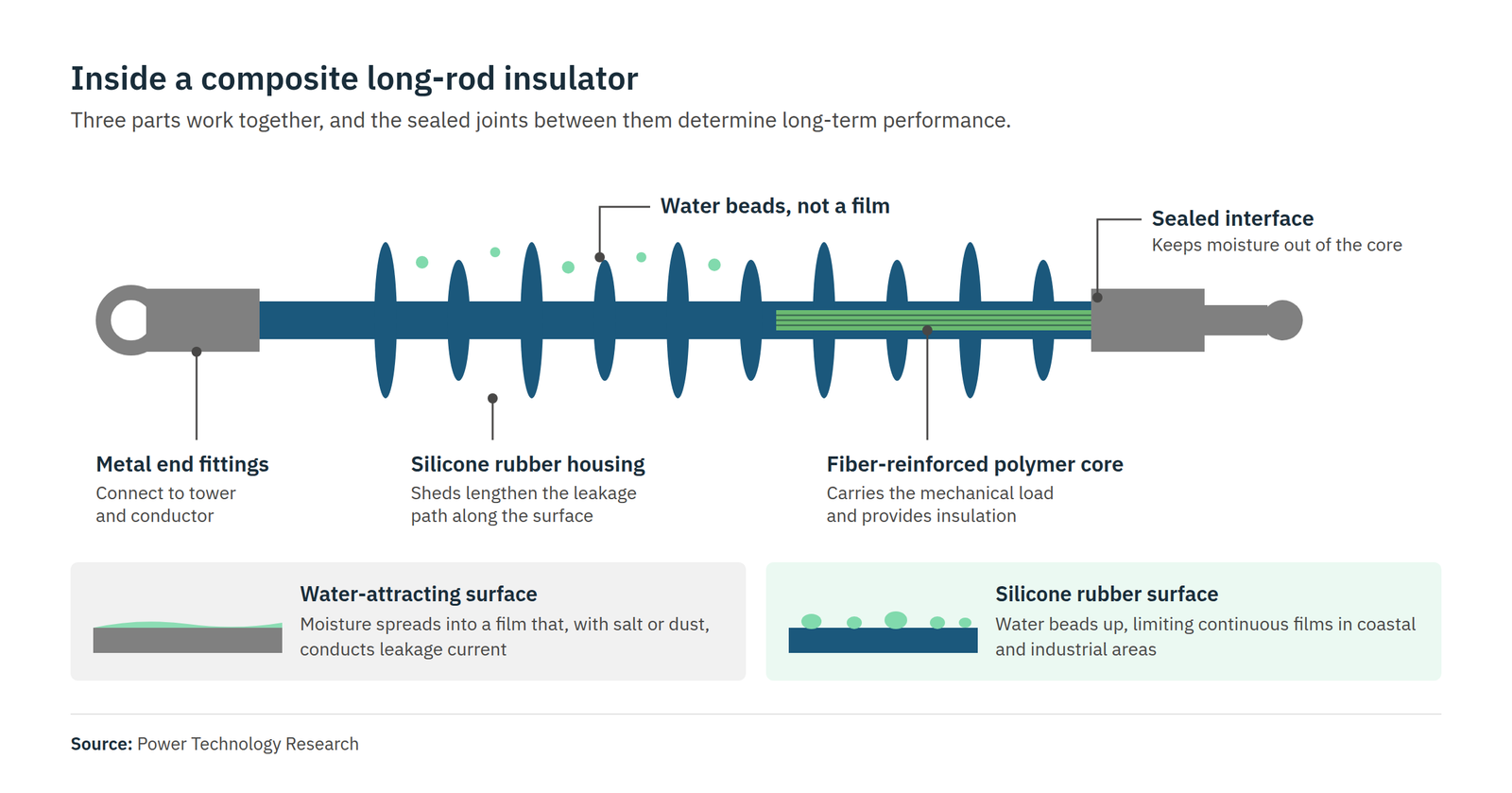
These characteristics are particularly useful in coastal and industrial environments. However, composite insulators remain susceptible to tracking, erosion, mechanical damage, moisture ingress, and deterioration at material interfaces. Their long-term performance depends on manufacturing quality, sealing integrity, electric-field distribution, and service conditions.
PTR’s 2026 market assessment identifies increasing preference for composite insulation in selected transmission applications, particularly where reduced weight, pollution performance, and installation requirements offer practical advantages. This does not imply uniform replacement of conventional materials. Porcelain and glass remain important where utilities prioritize established operating experience, existing specifications, and compatibility with installed equipment.
Innovation in conventional materials
Toughened glass disc insulators remain important where utilities value modular string construction and visible indications of certain types of damage. Porcelain also continues to serve line-post, station-post, and equipment-support applications.
One development involves applying room-temperature-vulcanized (RTV) silicone rubber coatings to glass insulators. These coatings aim to improve contamination performance through a hydrophobic surface while retaining the established characteristics of the underlying glass insulation.
EPRI has investigated RTV-coated glass insulators alongside research into porcelain aging and glass-insulator condition assessment. These developments offer utilities additional options when evaluating refurbishment, replacement, and long-term performance.
Updated standards and performance requirements
Recent revisions to international standards reflect improvements in how insulating materials and equipment designs are evaluated.
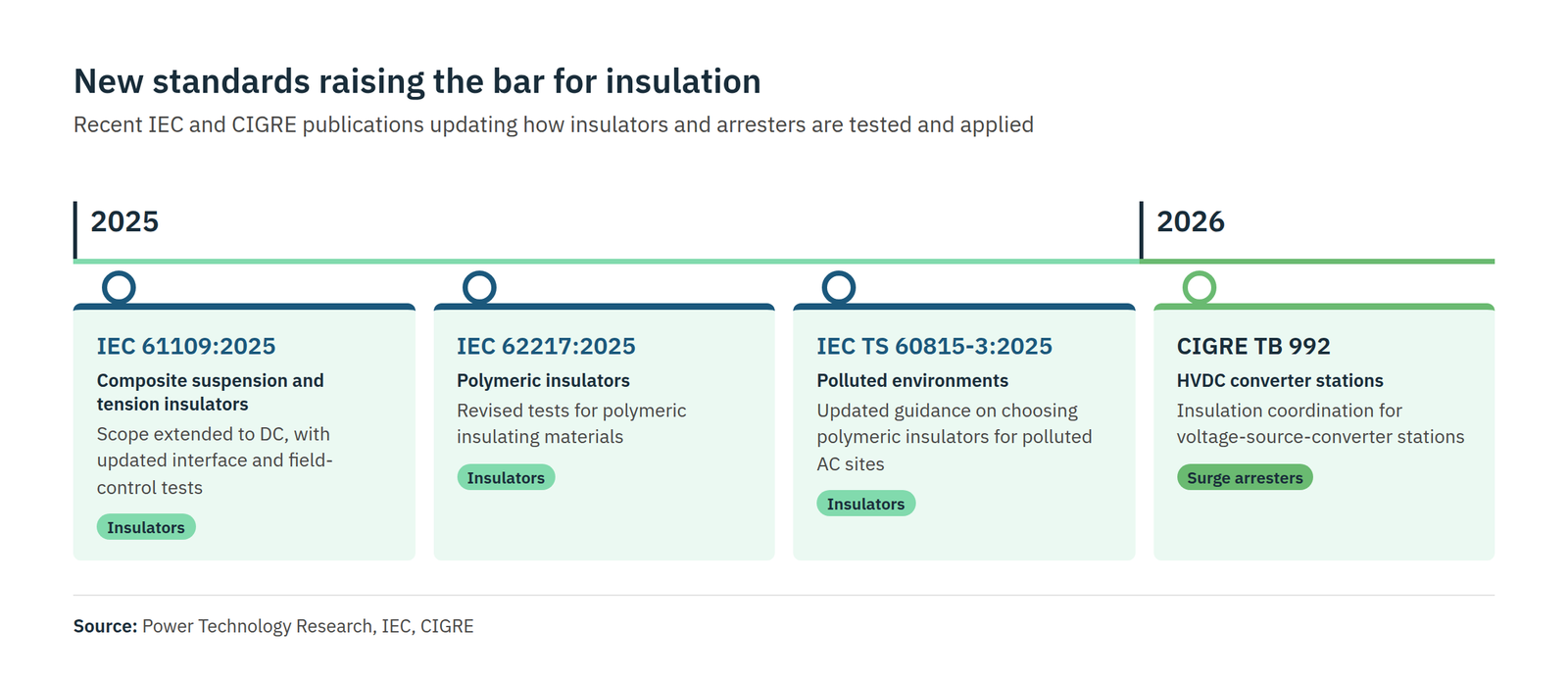
IEC 61109:2025 extends the scope of composite suspension and tension insulator requirements to DC applications and updates provisions relating to testing, material interfaces, and electric-field control. IEC 62217:2025 revises tests for polymeric insulators, while IEC TS 60815-3:2025 provides updated guidance for selecting polymeric insulators in polluted outdoor AC environments.
These developments matter because insulation performance cannot be determined from voltage rating or creepage distance alone. Site-pollution severity, material properties, surface geometry, and environmental conditions must also be considered.
The commercial implications extend beyond compliance. PTR’s research into utility purchasing practices points to the importance of technical qualification, type-test documentation, approved-vendor lists, and satisfactory operating experience. Even where a newer material offers practical advantages, manufacturers may need to demonstrate performance and secure utility approval before it can replace established designs.
Surge arrester technology: Construction and performance improvements
Most modern medium- and high-voltage AC surge arresters use metal-oxide varistors (MOVs), primarily based on zinc oxide. Their nonlinear voltage-current characteristics allow them to conduct relatively little current during normal operation and substantial current during overvoltage events, limiting the voltage imposed on protected equipment.
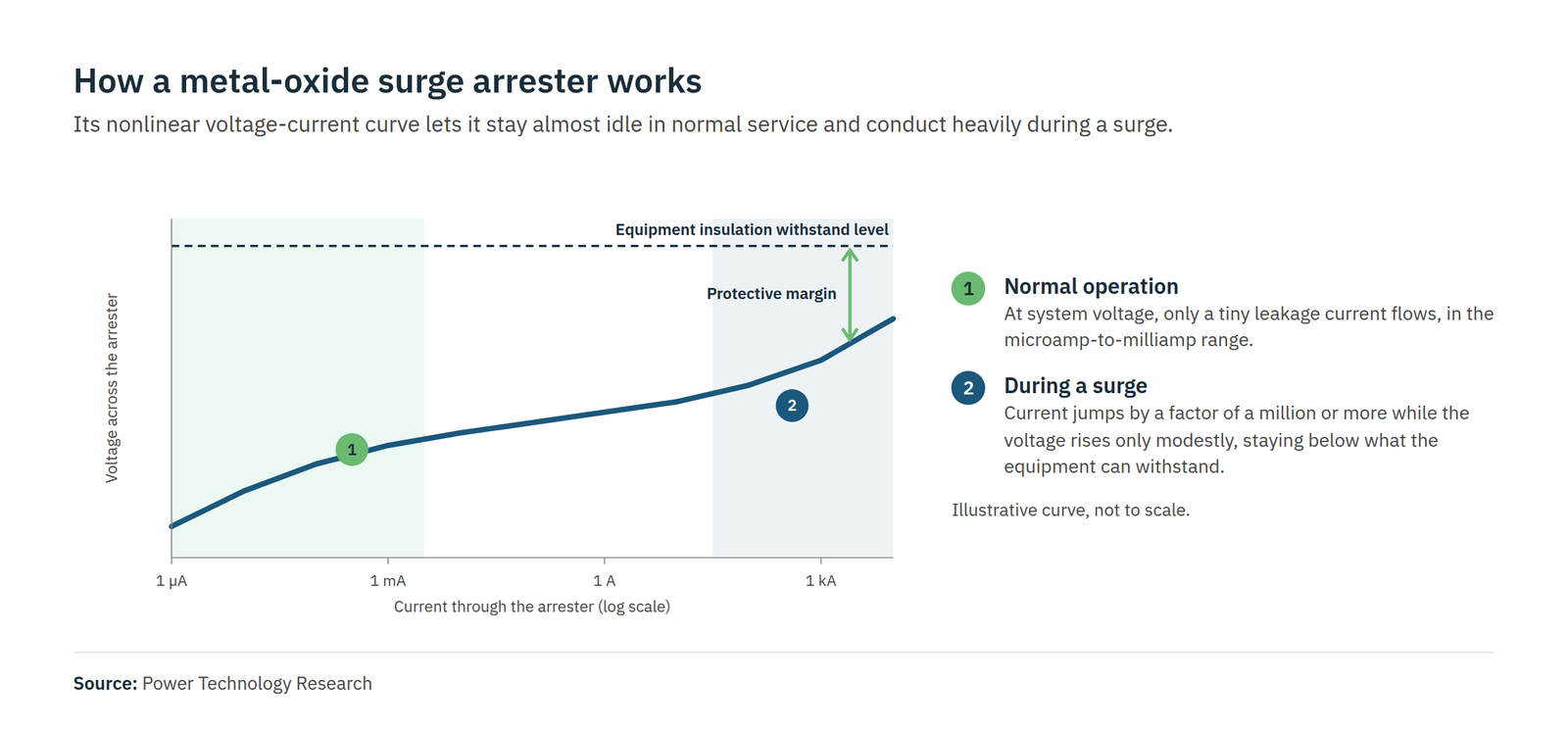
Although this protective principle is mature, arrester construction continues to develop. Porcelain-housed arresters have an extensive service history, particularly in high-voltage substations, while polymer-housed designs offer advantages such as lower weight, easier handling, and favorable surface properties in polluted environments.
Manufacturers have developed different polymeric construction methods, including fiber-reinforced polymer cage designs and composite hollow-core arrangements. These differ in mechanical construction, sealing, and behavior under abnormal conditions. Depending on the design, polymeric construction can also reduce hazards associated with fragmentation during an internal short circuit.
PTR’s regional market assessment indicates growing interest in polymer-housed surge arresters, while porcelain designs continue to serve established high-voltage and substation applications. Material preferences reflect more than housing performance: utility qualifications, installed designs, and equipment replacement practices can also influence purchasing decisions.
Regardless of housing material, arresters must be selected for the system’s continuous operating voltage, temporary-overvoltage duty, protective level, and energy or charge-transfer requirements.
Grid modernization: From surge counters to condition monitoring
Grid modernization involves more than expanding network capacity or replacing aging equipment. Utilities are also adopting digital technologies to improve visibility into asset condition, identify potential failures, and support more targeted maintenance. Surge arrester monitoring is one example of how these capabilities are extending to components that have traditionally received limited attention.
Traditionally, utilities have used surge counters to record discharge events and local instruments to measure leakage current. More advanced systems can collect operating information remotely, including leakage-current measurements and surge characteristics, allowing asset condition to be assessed more frequently.
Commercial systems such as Hitachi Energy’s EXCOUNT range illustrate these capabilities, providing additional operating information that utilities can incorporate into maintenance and asset-management processes.
What leakage-current measurements reveal
During normal operation, a small leakage current flows through a metal-oxide arrester, containing capacitive and resistive components. Changes in the resistive component may indicate deterioration of the MOV elements, making it useful for condition assessment.
Interpreting these measurements requires care. Operating voltage, temperature, harmonics, surface contamination, and moisture can influence readings. An increase in measured leakage current therefore does not automatically mean that an arrester is approaching failure. Reliable assessment requires appropriate measurement techniques and an understanding of operating conditions.
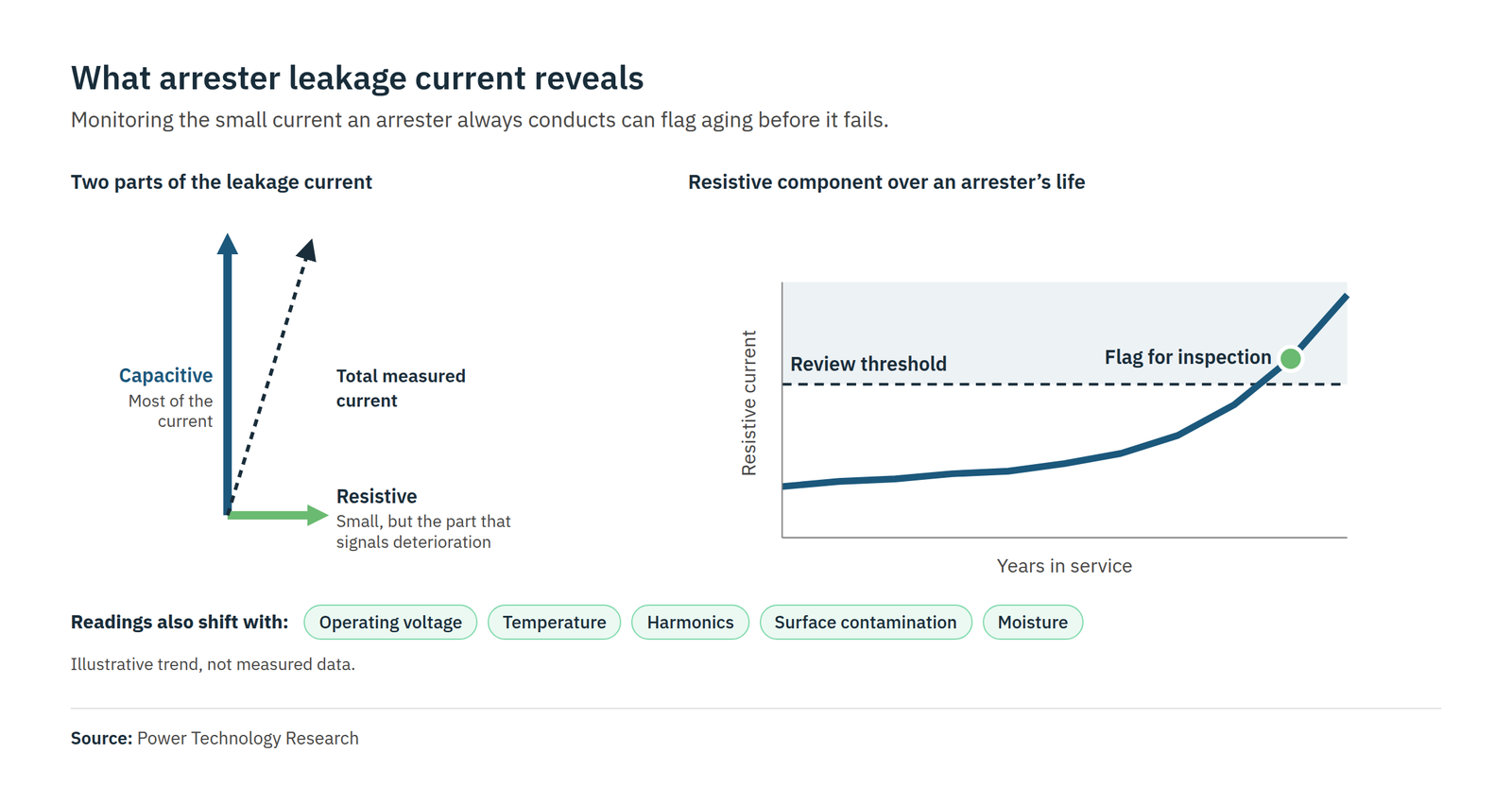
For critical substations, remote monitoring can support maintenance planning and help identify abnormal behavior earlier. The business case may differ for large populations of relatively inexpensive distribution arresters, where installation costs, communications infrastructure, and existing inspection practices influence the benefits.
The important development is not simply collecting more operating data, but using it to support better maintenance decisions.
HVDC: A different challenge for insulation coordination
High-voltage direct current (HVDC) transmission introduces additional considerations for surge protection and insulation coordination.
HVDC converter stations operate under electrical conditions that differ from conventional AC substations, including DC operating voltage and transients associated with converter operation, switching, and faults. Surge arresters are installed at selected locations to protect critical equipment, with their ratings and positions determined through insulation coordination studies.
CIGRE’s Technical Brochure 992, published in 2026, provides guidance on insulation coordination for voltage-source-converter HVDC stations, addressing overvoltage studies, arrester arrangements, and equipment withstand levels.
The application illustrates how established surge protection technologies must be adapted to increasingly specialized electrical infrastructure.
Regional operating conditions influence material selection
PTR’s regional assessment identifies different priorities across electricity markets, reflecting the balance between new infrastructure development, equipment replacement, operating conditions, and utility purchasing requirements.
In North America, aging transmission and distribution assets and grid-hardening programs support equipment replacement and the evaluation of alternative insulation materials. Established utility approvals and operating records remain important when introducing new designs.
Across Europe, transmission modernization, strict technical qualification, and challenging operating environments influence product selection. Composite long-rod insulators offer advantages in certain transmission applications, while conventional materials continue to serve established line and substation requirements.
In Asia, expanding transmission infrastructure and renewable energy connections create opportunities for different insulation and protection technologies. India provides an example: POWERGRID has issued tenders for composite long-rod insulators for transmission projects, while procurement requirements continue to emphasize testing and previous satisfactory performance.
In parts of the Middle East and Africa, dust, salt contamination, high temperatures, and coastal exposure can make pollution performance and material durability particularly important. Polymeric surfaces may offer advantages, but utilities must also consider long-term aging and maintenance.
These regional differences support a finding from PTR’s research: the adoption of composite materials depends as much on the application and utility’s technical requirements as on the material’s inherent advantages.
What these developments mean for the market
The longer-term outlook for electricity networks provides important context for both product categories. In its Electricity Grids and Secure Energy Transitions analysis, the IEA estimated that more than 80 million kilometers of grids would need to be added or refurbished by 2040 in a scenario where national energy and climate goals are met.
Data centers add another source of demand. The IEA’s updated 2026 outlook projects global data-center electricity consumption rising from approximately 485 TWh in 2025 to 950 TWh by 2030. Large new facilities can require dedicated grid connections and substation capacity, bringing associated requirements for medium- and high-voltage insulation and surge protection.
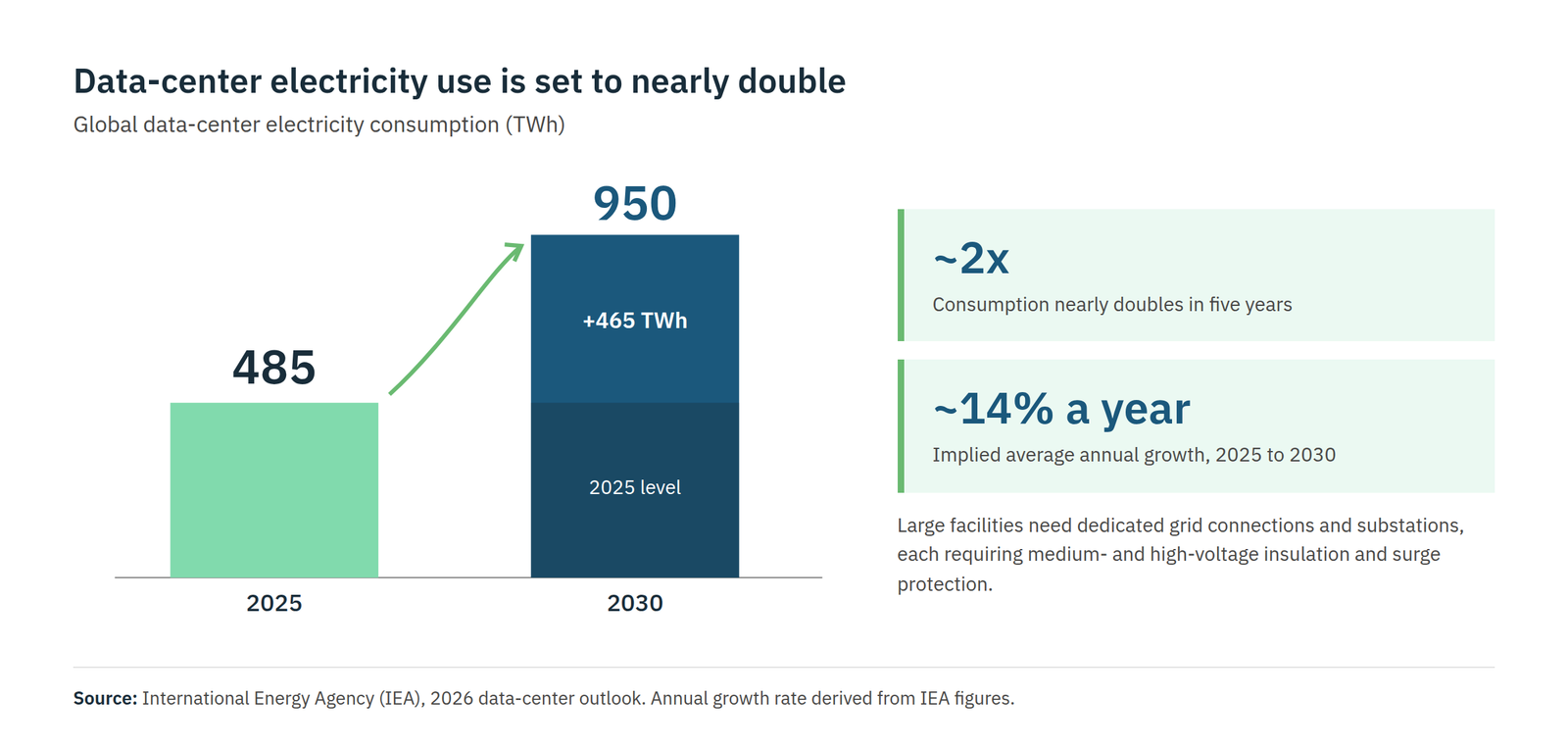
However, grid investment does not translate directly into component demand. Overhead lines, underground cable projects, substations, and HVDC converter stations require different equipment configurations.
PTR’s market assessment highlights an important distinction between equipment volume and market value. Distribution networks can account for substantial unit demand because of the number of installed assets and protected connection points. Higher-voltage transmission and substation applications, meanwhile, can contribute disproportionately to demand in terms of revenue because of their technical requirements and higher equipment prices.
The material mix adds another consideration. A composite long-rod insulator and a string containing multiple glass or porcelain discs may provide comparable insulation functions while representing different physical-unit counts. Consequently, changes in material preference do not necessarily translate into proportional changes in the number of units sold.
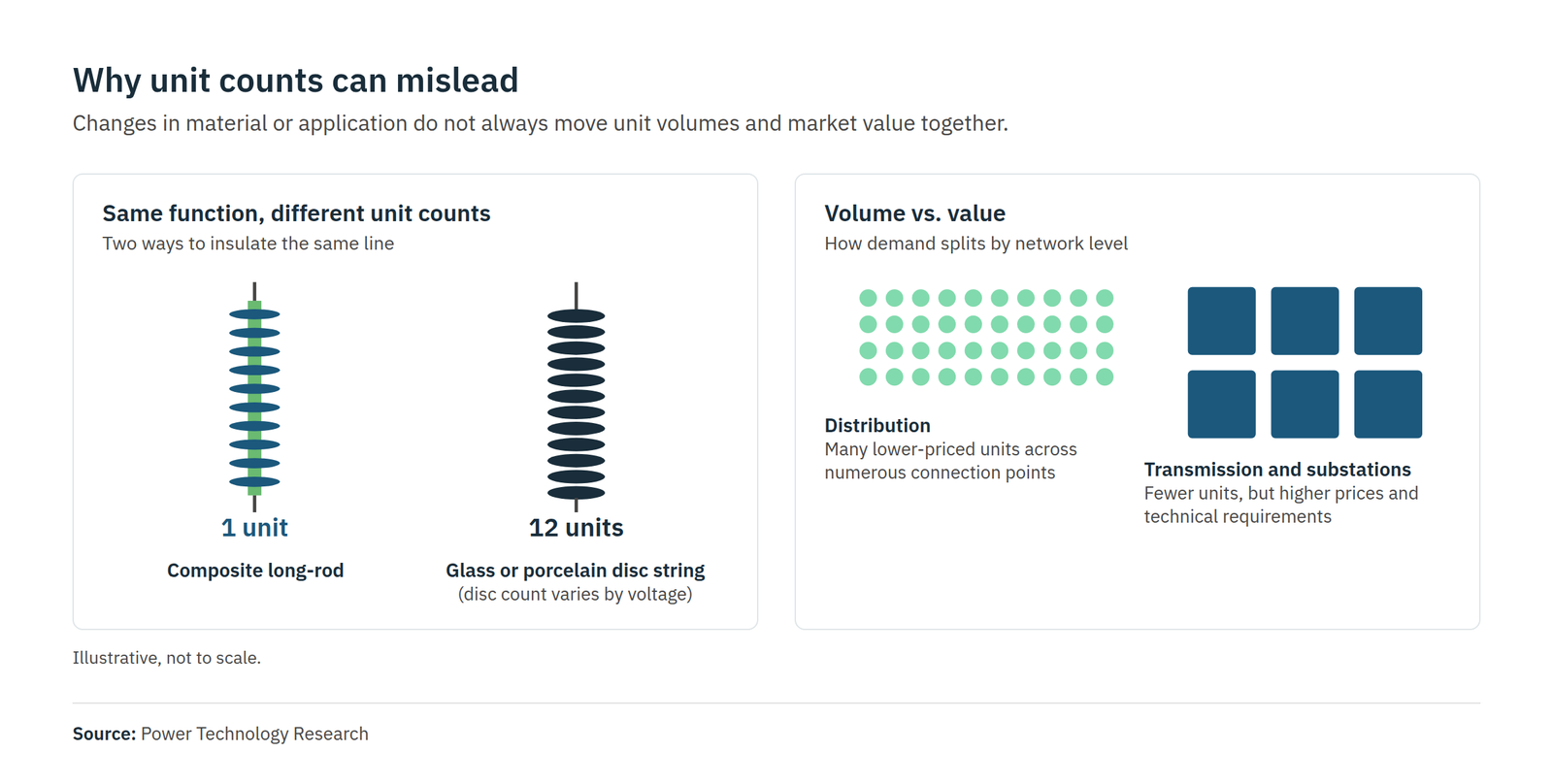
This distinction is important when evaluating the market impact of grid expansion, equipment replacement, and technology adoption.
The next phase of grid protection
Progress in surge arresters and insulators is taking place through improvements in material performance, testing, monitoring, and application-specific engineering rather than a single technological breakthrough.
For insulators, updated qualification standards and research into material aging are improving the basis for equipment selection. For surge arresters, advances in housing construction, condition monitoring, and insulation coordination provide utilities with additional protection and maintenance options.
PTR’s assessment points to a market in which technical performance and practical purchasing considerations will continue to shape adoption. Manufacturers must respond not only to changing electrical and environmental requirements, but also to established utility standards, qualification processes, and lifecycle expectations.
As electricity networks expand and modernize, the effective selection and coordination of insulators and surge arresters will remain essential to protecting equipment and maintaining reliable electricity supply.
Service Overview
The research presented in this article is from PTR's market research. For information about our services please submit a request shown below.