
As electricity networks expand and become more digital, protection systems are changing with them. PTR’s recent research into medium-voltage protection relays found a market shaped not only by grid expansion and equipment replacement, but also by changes in how protection is integrated with automation, communications, and software. IEC 61850, process bus, centralized protection, and virtualization are gradually widening the role of the traditional protection relay.
Protection demand is growing with the grid
Protection relays perform a fundamental task in electrical networks: identifying abnormal conditions and initiating the isolation of affected equipment before damage spreads. The principle has changed little, but the networks they protect are becoming more complex.
The IEA expects global electricity demand to grow by an average of 3.6% annually between 2026 and 2030. Industrial growth, electric vehicles, cooling, data centers, and other new loads are increasing electricity consumption, while renewable generation and storage continue to add new connection points. Around US$400 billion is currently invested in grids each year, and the IEA estimates that annual investment would need to rise by roughly 50% by 2030 to support expected demand.
For protection relay suppliers, the relevance lies in the infrastructure behind those figures. New substations, renewable interconnections, feeder reinforcement, large-load connections, and replacement of aging equipment all require protection, although the number and type of relays vary considerably between projects.
PTR’s recent MV protection relay research examined these demand drivers alongside applications, procurement behavior, and technology adoption. One recurring finding was that new-build and replacement projects behave very differently. A new renewable collector substation or data center can be designed around current automation and communication requirements from the beginning. An existing utility substation may already have protection settings, panel wiring, SCADA interfaces, maintenance practices, and staff experience built around an established relay platform.
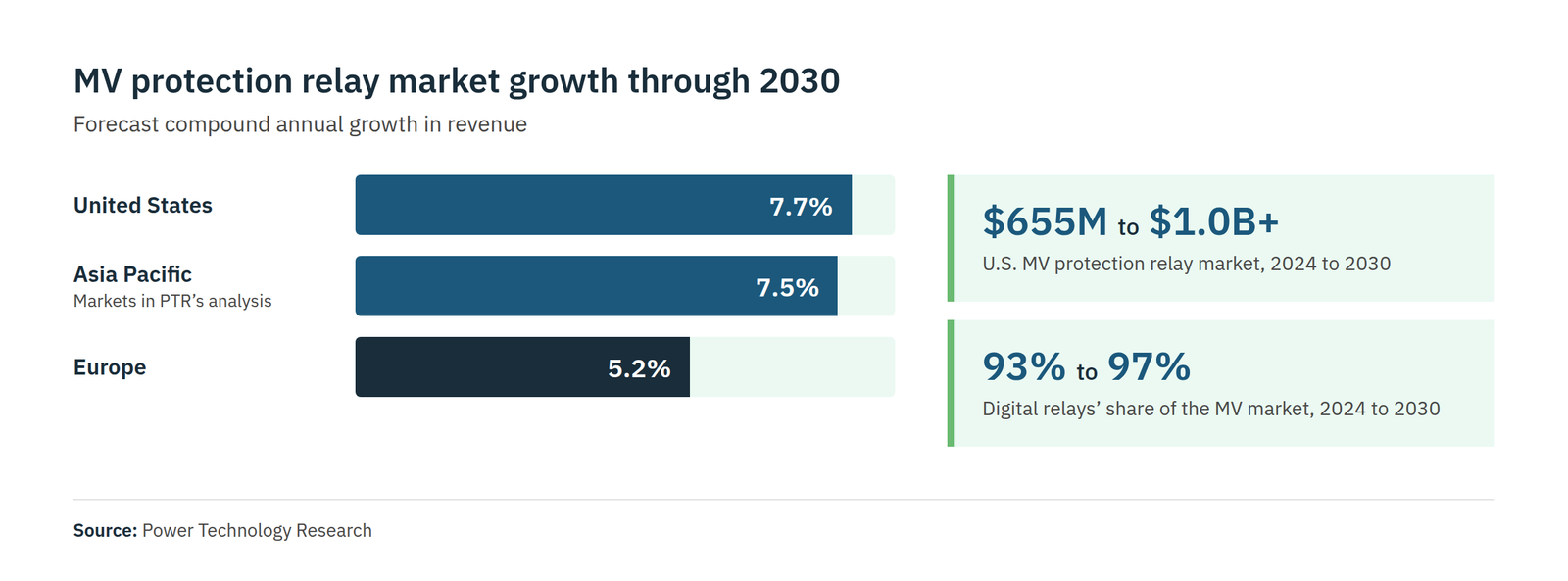
Regional adoption patterns reflect the same divide. North America combines a large installed protection base with new demand from utility investment, data centers, industrial projects, and renewable connections. In the U.S., PTR estimates the MV protection relay market at about US$655 million in 2024, rising to just over US$1.0 billion by 2030, a 7.7% CAGR. Established relay fleets and utility qualification processes nevertheless make technology changes in existing substations gradual.
In several Latin American markets, renewable development and grid expansion create a larger greenfield component, with EPC contractors often influencing equipment selection. Across the Asia Pacific markets included in PTR’s analysis, MV protection relay revenue is forecast to grow at about 7.5% annually through 2030, compared with about 5.2% in Europe. Parts of Asia Pacific have more new network construction, while Europe is more strongly shaped by modernization of an established grid, where interoperability, cybersecurity, IEC 61850 integration, and utility qualification increasingly affect product selection. PTR’s findings suggest that adoption depends as much on the investment mix and installed base as on technology availability.
Digital protection is moving beyond the standalone relay
Digital relays are already the norm. Across the MV markets assessed by PTR, they accounted for approximately 93% of the market in 2024, with their share expected to reach around 97% by 2030. Electromechanical relays remain in parts of the installed base where compatibility, panel design, or operating requirements make replacement difficult. The relevant technology discussion is therefore no longer simply digital versus electromechanical. The more interesting change is taking place within digital protection.
Modern intelligent electronic devices can combine feeder or transformer protection with breaker control, measurements, event recording, diagnostics, and communications. Functions that once required several devices can increasingly be incorporated into one platform, while information from the relay can be shared with SCADA and substation automation systems.
IEC 61850 has been central to this development. GOOSE messaging allows protection and control information to be exchanged between IEDs, while Sampled Values can carry digitized current and voltage measurements. The standard is well established; more recent work is focused on making these digital interfaces dependable enough for increasingly important protection functions.
IEC TS 60255-216-1:2025 addresses protection functions using digital inputs and outputs, including Sampled Values, GOOSE messages, trip signals, and time synchronization. In October 2026, IEC PAS 61850-90-28:2026 added requirements for how subscriber IEDs validate received GOOSE and Sampled Value messages. As protection depends more on networked data, the quality and validation of that data become part of dependable protection operation.
Process bus and centralized protection change the architecture
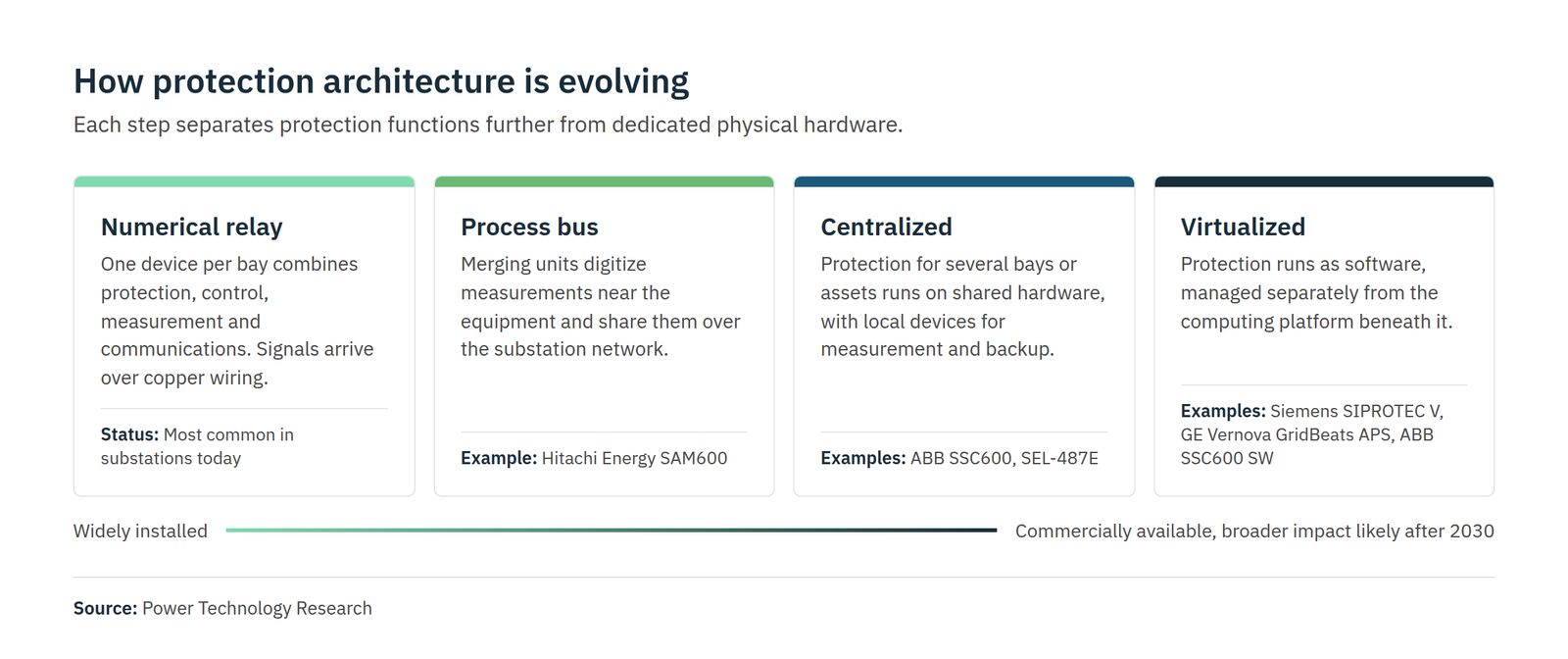
A conventional numerical relay may have sophisticated digital algorithms while still receiving current and voltage signals through dedicated copper wiring. In a process-bus architecture, merging units digitize these measurements near the primary equipment and publish Sampled Values over the substation network. Protection IEDs can subscribe to the information they require, allowing measurement interfaces and protection functions to be located separately.
Process bus can reduce point-to-point copper wiring, but its wider significance is making measurements available to several protection and control applications. Hitachi Energy’s SAM600 is one example of a process-interface device serving this role. The architecture also requires utilities to engineer network redundancy, time synchronization and end-to-end testing as part of the protection scheme.
Centralized protection builds on these digital interfaces by running functions for several bays or assets on shared protection hardware. Merging units or other local devices can continue to provide measurements, equipment interfaces and backup functions. The extent of consolidation depends on the application: a multi-asset relay for a small substation and a station-level platform supporting many bays do not represent identical architectures.
Commercial implementations already illustrate that range. ABB’s SSC600 centralizes protection and control for distribution substations, while the SEL-487E can protect multiple assets, including transformer, bus and feeder circuits, within one dedicated relay. Neither approach should be confused with hardware-independent virtualization. In February 2026, ABB also introduced its REX600 as a digital process-interface device combining merging-unit functionality, backup protection and fault detection for conventional as well as centralized and virtualized systems.
Consolidation changes the engineering of the complete protection system, not just the device count. Shared platforms require appropriate redundancy, backup arrangements and testing to maintain dependable fault clearance. For buyers, the comparison is therefore between complete protection architectures rather than the price of one relay against another.
Virtualized protection: commercial products, gradual adoption
Virtualized protection separates protection applications from dedicated protection hardware more fully than centralized protection alone. CIGRE describes virtualized protection and control as an architecture in which software applications can be managed separately from the underlying computing platform, with IEC 61850 providing interfaces to the substation. This is a further step in architecture, not simply a different name for a multifunction or centralized relay.
Commercial products and field experience now provide concrete examples. The ABB–Caruna pilot tested virtualized protection functions in an operating Finnish substation, and ABB offers SSC600 SW as a software-only protection-and-control package for supported computing environments. Siemens introduced SIPROTEC V in February 2026, using shared substation-grade computing hardware for virtualized SIPROTEC protection applications. GE Vernova launched GridBeats APS in the same month, describing an architecture that supports conventional, process-bus and centralized systems and enables Virtual Protection Relays through hardware abstraction.
For utilities, software that is less tied to a particular device could simplify some upgrades, spare-hardware strategies and the addition of protection functions over a substation’s operating life. These potential benefits do not remove the need for engineered redundancy, suitable computing performance, cybersecurity, application isolation and careful software change control. Shared infrastructure can also create common failure modes that have to be addressed at system level.
CIGRE’s ongoing work on virtual IEDs reflects the work still required on specification, testing, commissioning and maintenance. Established suppliers can offer virtualized solutions today, but product launches and successful pilots should not be read as evidence of widespread utility deployment.
Utility qualification cycles, installed protection fleets and the cost of upgrading secondary systems mean adoption is likely to be gradual. Virtualized protection may have a more substantial effect on protection markets after 2030, even though commercial products are available now. This distinction between technology availability and market penetration is important when discussing its forecast impact.
Digital protection raises new lifecycle requirements
As protection systems rely more heavily on communications and software, their testing and maintenance requirements also change. PTR’s research identifies interoperability, engineering support and cybersecurity among the considerations influencing advanced digital-relay procurement. Utilities increasingly need to assess those capabilities alongside familiar protection requirements such as selectivity, operating time and dependability.
A conventional scheme can often be tested mainly through relay settings, physical wiring and injected signals. With IEC 61850-based architectures, protection operation may also depend on Sampled Values, GOOSE messages, network configuration and time synchronization. IEC guidance now addresses the validation of received GOOSE and Sampled Value messages, making communication behavior a specific part of protection verification.
Software platforms add lifecycle considerations. Siemens’ technical documentation describes cybersecurity and system-management functions for SIPROTEC V, while GE Vernova’s documentation describes separating core protection-and-control firmware from platform functions such as communications and cybersecurity. The intended benefit is greater flexibility in maintaining those components, although changes must still be assessed and tested according to their effect on the protection system.
What this means for the protection relay market
PTR’s application-level research also indicates a gradual change in the sources of relay demand. Utilities accounted for approximately 50% of MV protection relay revenue across the markets studied in 2024, with their share expected to decline slightly to 47% by 2030. Meanwhile, the rest-of-industry segment, which includes data centers and other industrial applications, is forecast to increase from 27% to 30%. This reflects faster growth in selected industrial applications rather than a decline in utility demand.
One of the more interesting conclusions from PTR’s work is that digitalization may gradually change how the protection market itself is evaluated.
Historically, physical relay volumes provided a useful indication of market activity. That becomes less straightforward as multifunction relays combine more functions and centralized platforms support protection across multiple assets. Growth in the number of protection functions installed may no longer correspond directly with growth in the number of physical relay units.
The value does not disappear; it moves within the system. Protection software, merging units, industrial computing, Ethernet infrastructure, cybersecurity, engineering tools, testing, and lifecycle support can account for a greater share of the overall solution.
For suppliers, this broadens the basis of competition. Reliable and selective protection remains the fundamental requirement, but utilities and other customers are also evaluating interoperability, engineering tools, cybersecurity, software management, system validation, and long-term support. PTR’s research also reinforces the importance of qualification and installed-base familiarity: a technically advanced architecture still has to fit the customer’s protection philosophy, operating practices, and tolerance for change.
This makes protection relays an interesting market to watch. Grid expansion and equipment replacement continue to support demand for the traditional product, while digitalization is gradually changing what customers are actually buying around it.
Conventional numerical IEDs will remain important for years, but they will increasingly coexist with process bus, centralized protection, and virtualized architectures. The fundamental protection requirement remains unchanged; the technology used to deliver it is becoming more flexible, more integrated, and less dependent on one dedicated physical device.
Service Overview
The research presented in this article is from PTR's market research. For information about our services please submit a request shown below.