
Utilities are being asked to connect more power, faster, than at any point in decades, and the substation has become a bottleneck. Renewables, battery storage, electrified transport and heating, and large new loads such as data centers all need grid connections, and each one needs switchgear, protection and control equipment, and somewhere to house it.
The conventional answer, a purpose-built substation, means civil works, staggered equipment deliveries and long on-site assembly, all exposed to weather and labor shortages. A growing number of utilities are choosing a different route: the e-house. An e-house is a prefabricated, factory-tested enclosure that houses switchgear, protection and control systems, and auxiliary equipment, and arrives on site ready to connect.
The global market for e-houses in utilities is forecast to grow at a compound annual rate of nearly 9% through 2030. Behind that figure are three distinct markets: distribution, generation and transmission, each shaped differently across APAC, EMEA and the Americas.
Why utilities are turning to e-houses
- Speed to energization. With the building and its equipment designed, built and tested in parallel in a factory, site work shrinks to foundations and final connections. Siemens says this can cut lead times by up to 50% (Siemens).
- A smaller footprint. E-houses typically need 30–50% less land than a conventional substation and sit on simple piers or steel supports (PTQ, Q3 2026), which matters in dense cities and on constrained sites.
- Less risk on site. Factory testing finds problems before the unit ships, reducing safety exposure, weather delays and trade coordination. Many units can also be relocated as load patterns change.
- The trade-off. An integrated package usually costs more upfront than separately procured components. Utilities that choose e-houses are buying schedule certainty and risk transfer, and the case rests on total installed cost and time to energization.
Where e-houses sit in the utility grid
The same basic product serves three very different parts of the power system.
Distribution: the volume engine
Distribution is the largest application. Utilities add and upgrade many mid-sized substations every year: primary substations stepping down to 11 kV, compact units on tight urban sites, rural electrification schemes, and new connections for EV charging hubs and housing developments. Because these projects repeat, standardized factory-built designs pay off across many sites. In India, for example, Hartek Power is delivering two turnkey 33/11 kV e-house substations for a Tata Power distribution venture in Odisha (pv magazine India).
Generation: riding the renewables buildout
In generation, e-houses serve as collector and step-up substations at solar and wind farms, as the grid interface for battery storage, as onshore substations for offshore wind, and as auxiliary power rooms at thermal and hydro plants. For renewable projects, connecting weeks earlier is often worth more than any equipment saving.
Transmission: small but critical
Transmission is the smallest application, because most high-voltage equipment stays outdoors. Here e-houses mainly serve as protection and control buildings, as enclosures for gas-insulated switchgear, and as mobile substations for emergency restoration, giving them an outsized role in grid reliability.
One product, three regional markets
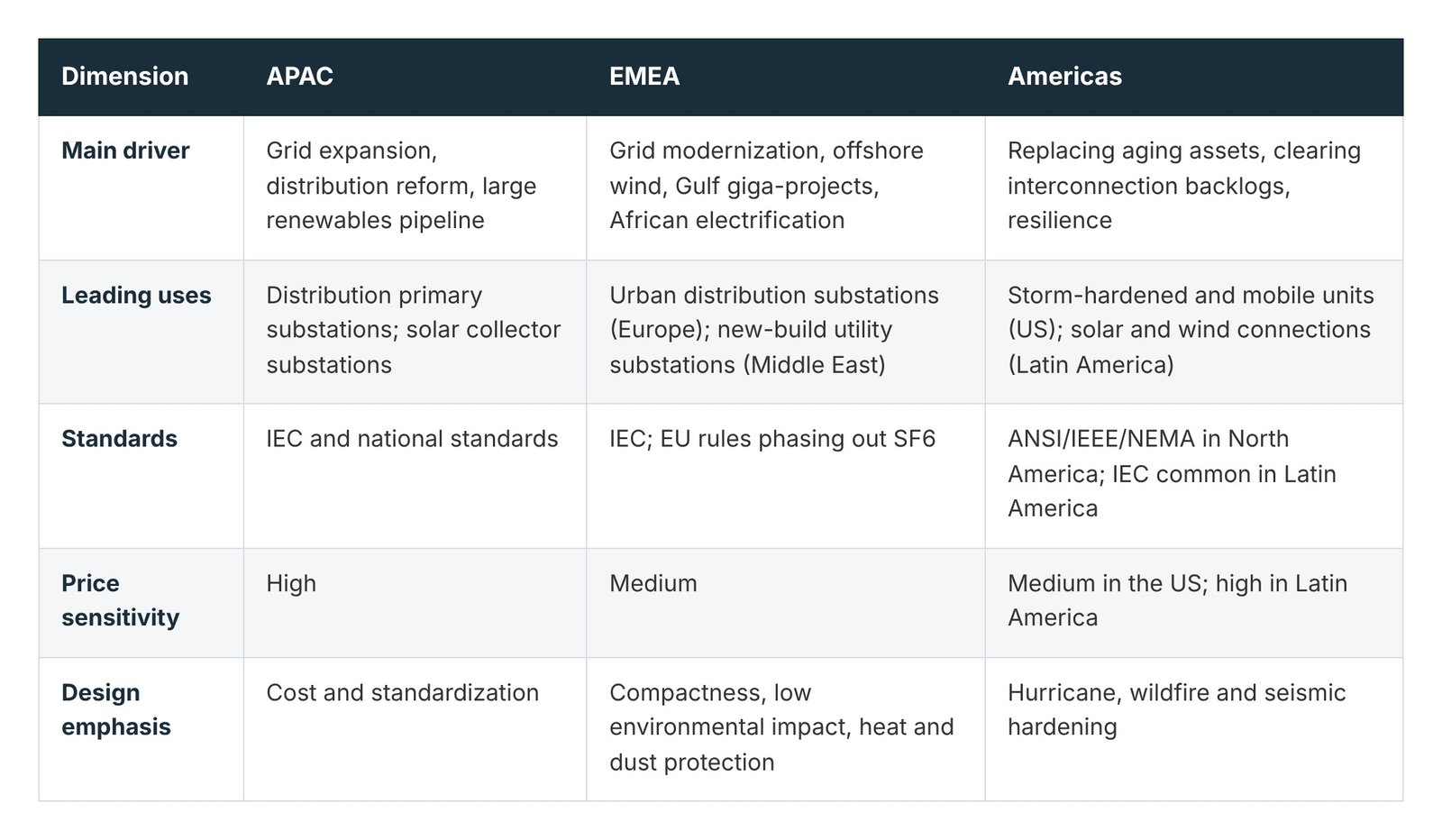
The e-house is a global product, but utilities in APAC, EMEA and the Americas buy it for different reasons and specify it differently.
APAC
APAC is defined by scale. China has long used standardized prefabricated substations, and a deep domestic supplier base keeps prices competitive. India’s distribution reforms, Australia’s renewable energy zones and electrification across Southeast Asia add demand, with buyers focused on cost and repeatable designs.
EMEA
EMEA is really three markets. European operators need compact, low-impact designs for crowded cities, and the EU’s phase-out of SF6 is pushing alternative switchgear into e-houses. Gulf utilities need units engineered for extreme heat and sand, while African utilities value relocatable and mobile capacity.
The Americas
The Americas are driven by renewal and resilience. North American utilities are replacing aging assets, clearing interconnection queues and specifying enclosures hardened against hurricanes, wildfires and earthquakes, built to ANSI/IEEE standards. In Latin America, solar and wind in Chile and Brazil and Brazil’s transmission auctions lead demand.
Trends, constraints and suppliers
What goes inside the e-house is changing fast. Digital substations built on IEC 61850 enable remote monitoring and condition-based maintenance, SF6-free switchgear is spreading, mobile units support rapid restoration, and e-houses increasingly connect battery storage. Catalog-style standard designs are also cutting engineering time.
Adoption still faces limits. Transport size and weight caps restrict how much equipment one module can carry, long lead times for transformers and switchgear can erase the schedule gain, and procurement rules that tender components separately make integrated packages harder to compare.
The market combines global suppliers such as ABB, Siemens, Schneider Electric, Hitachi Energy, Eaton, GE Vernova and WEG with regional specialists, notably Chinese prefabricated substation makers and Indian engineering firms. As utilities place larger framework orders, delivering repeatable units at volume is becoming as important as engineering depth.
Conclusion
With the utility e-house market forecast to grow at nearly 9% a year through 2030, demand spans the whole grid: distribution substations driven by electrification, generation connections driven by renewables and storage, and transmission applications centered on protection and resilience. Regionally, APAC competes on scale and cost, EMEA on compactness and harsh-climate engineering, and the Americas on renewal and resilience.
For utilities, the question is shifting from whether to use e-houses to where they deliver the most value. As grids race to connect new generation and new load, the substation that arrives in a box may be the one that arrives on time.
Service Overview
The research presented in this article is from PTR's market research. For information about our services please submit a request shown below.