
Medium-voltage switchgear rarely makes headlines, but it sits at the center of almost every major trend in the US power sector. Manufacturing construction, data center growth, renewable energy and storage, and a federal and state push to modernize the grid are all driving demand. At the same time, new environmental rules are changing which technologies utilities can buy.
The market divides into two main insulation technologies: air-insulated switchgear (AIS) and gas-insulated switchgear (GIS), with solid-insulated switchgear (SIS) emerging as an alternative. Each is growing for different reasons.
AIS: the workhorse of utilities and industry
In the US, demand for primary AIS in the 24–42 kV class is rising across industrial and renewable energy substations. Much of this is linked to the boom in manufacturing construction, where spending in 2024 reached roughly three times 2021 levels.
AIS remains the preferred medium-voltage solution for utilities and private networks because it is cost-effective, broadly compatible and quick to deploy.
Utility distribution and industry account for most demand for higher fault-level AIS, driven by dense network configurations and higher system fault contributions. Conventional generation also relies mainly on higher short-circuit-rated AIS units rather than GIS.
Utility procurement is getting a further boost from an expected $1.1 trillion in grid investment between 2025 and 2029, which is driving large orders for utility feeders and substation renewals. GIS and SIS adoption is rising in selected new builds, but AIS remains the default for most of the network.
GIS: built for greenfield growth
GIS expansion is being propelled by greenfield projects in the renewable energy and data center sectors. Again, the 24–42 kV class captures the majority of new demand, around 80%, driven by utility sub-transmission reinforcement and new solar and wind connections.
- Battery energy storage: A key emerging driver. GIS is critical for integrating storage capacity, which is forecast to grow from 80 GWh in 2024 to 700 GWh by 2030.
- Data centers: A much bigger customer. Their share of annual medium-voltage GIS demand is forecast to roughly double, from 8% in 2024 to about 16% by 2030.
What is driving demand
- Rising load growth: According to NERC’s 2024 Long-Term Reliability Assessment, summer peak demand is set to rise by 132 GW and winter peak demand by 149 GW through 2034. This is accelerating grid expansion and substation development, and driving demand for switchgear in new feeder extensions and greenfield substations.
- Undergrounding and aging infrastructure: Both are reinforcing demand for GIS and SIS technologies.
- Utility-scale renewables and storage: The accelerated build-out of renewable and storage capacity is driving new substation and feeder deployments.
- Policy and investment cycles: National and utility-led initiatives are funding efforts to harden the grid, replace aging assets and improve reliability through 2030.
- Data centers: Hyperscale loads require highly reliable medium-voltage switching, with redundant feeders, fast fault clearing and fault-tolerant architecture.
- Industrial growth and EV adoption: The industrial greenfield boom adds significant demand, while EV adoption is a smaller but still meaningful driver.
The move away from SF6
SF6, the insulating gas used in conventional GIS, is a potent greenhouse gas, and state and federal sustainability mandates are accelerating the transition to SF6-free GIS and SIS. This is a global trend that is now gaining pace in the US.
Despite starting from a small base, SF6-free GIS demand is scaling rapidly. Between 2024 and 2030, primary units are growing at around 27% CAGR and secondary units at around 36% CAGR.
State policy is setting the pace
- California: Under California Air Resources Board (CARB) regulations, utilities must begin phasing out purchases of new SF6-based switchgear, with a complete ban on SF6 equipment purchases targeted for 2033.
- New York: The Department of Environmental Conservation’s proposed Part 495 regulation mirrors CARB’s approach, with a phase-out starting in 2026.
Manufacturers are responding
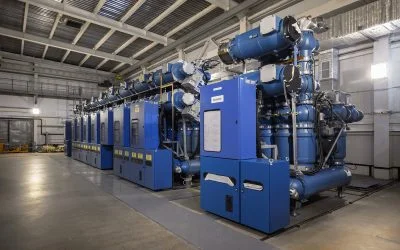
Siemens already markets its blue GIS portfolio in North America, and companies including G&W Electric, Eaton, ABB and Schneider Electric have introduced SF6-free alternatives for the market.
Digital switchgear is gaining ground
Digital switchgear is expected to grow by 35–40% in North America between 2025 and 2030. The drivers include data center expansion and automation needs, grid modernization and reliability goals, the convergence of protection and control systems, and the growth of distributed energy resources and smart grids.
Process bus architectures based on IEC 61850-9-2 and sensor-based protection are also helping to accelerate automation at the medium-voltage distribution level.
Adoption still faces barriers:
- Utility constraints: Budget and time constraints, cybersecurity risks, compatibility issues and the need for additional staff training.
- Market constraints: A shortage of skilled labor and high capital costs.
The outlook
AIS will remain the backbone of US utility and industrial networks for the foreseeable future, supported by grid investment and manufacturing growth.
The faster growth, however, is in GIS and SIS, especially SF6-free and digital designs, driven by data centers, storage, undergrounding and tightening environmental rules.
Medium Voltage Switchgear Service Overview
The research presented in this article is from PTR's Medium Voltage Switchgear market research. For information about this service please submit a request shown below.
Europe: +49-89-12250950
Americas: +1 408-604-0522
Japan: +81-80-7808-1378
GCC/Rest of APAC: +971-58-1602441
More About our: Medium Voltage Switchgear Market Analysis
Recent Insights
SF₆-Free MV Switchgear: California and New York Have Set the Clock
For decades, SF₆ has been the default insulating gas in medium voltage GIS. In two of the largest US states, that era now has an end date. Sulfur hexafluoride (SF₆) is an exceptionally effective insulating gas, and one of the most potent greenhouse gases known. State...
Data Centers Are the Fastest-Growing Market for US Medium Voltage Switchgear
Utilities still buy most of the US medium voltage switchgear market. But no customer group is growing faster than data centers, and they are changing what kind of switchgear gets bought. The US medium voltage (MV) switchgear market is worth about $4.9 billion in...
Wildfire Risk Is Changing How Western US Utilities Switch Their Feeders
When a spark can start a wildfire, the way a utility opens and closes a circuit becomes a safety decision. In the West, that is reshaping the equipment on overhead feeders. Across California, Oregon, Colorado and other fire-prone states, utilities have launched...
SF₆-Free MV Switchgear: California and New York Have Set the Clock
For decades, SF₆ has been the default insulating gas in medium voltage GIS. In two of the largest US states, that era now has an end date. Sulfur hexafluoride (SF₆) is an exceptionally effective insulating gas, and one of the most potent greenhouse gases known. State...
Data Centers Are the Fastest-Growing Market for US Medium Voltage Switchgear
Utilities still buy most of the US medium voltage switchgear market. But no customer group is growing faster than data centers, and they are changing what kind of switchgear gets bought. The US medium voltage (MV) switchgear market is worth about $4.9 billion in...
Wildfire Risk Is Changing How Western US Utilities Switch Their Feeders
When a spark can start a wildfire, the way a utility opens and closes a circuit becomes a safety decision. In the West, that is reshaping the equipment on overhead feeders. Across California, Oregon, Colorado and other fire-prone states, utilities have launched...
Manual Today, Motorized Tomorrow: Why the Air Break Switch Still Has a Place in the Smart Grid
Smart-grid headlines focus on reclosers, sensors and software. Out on the poles, one of the oldest devices on the network is quietly being upgraded rather than replaced. The three-phase ganged air break switch is one of the most familiar pieces of equipment in...